Homebrew / Open-Source · Volume 7
Homebrew & Open-Source Analog Computers — Volume 7 — Licences, provenance and where the modern machines depart
The licence audit in full, the departures from the 1960s machines that are real and the ones that only look real, and the questions this dive could not settle
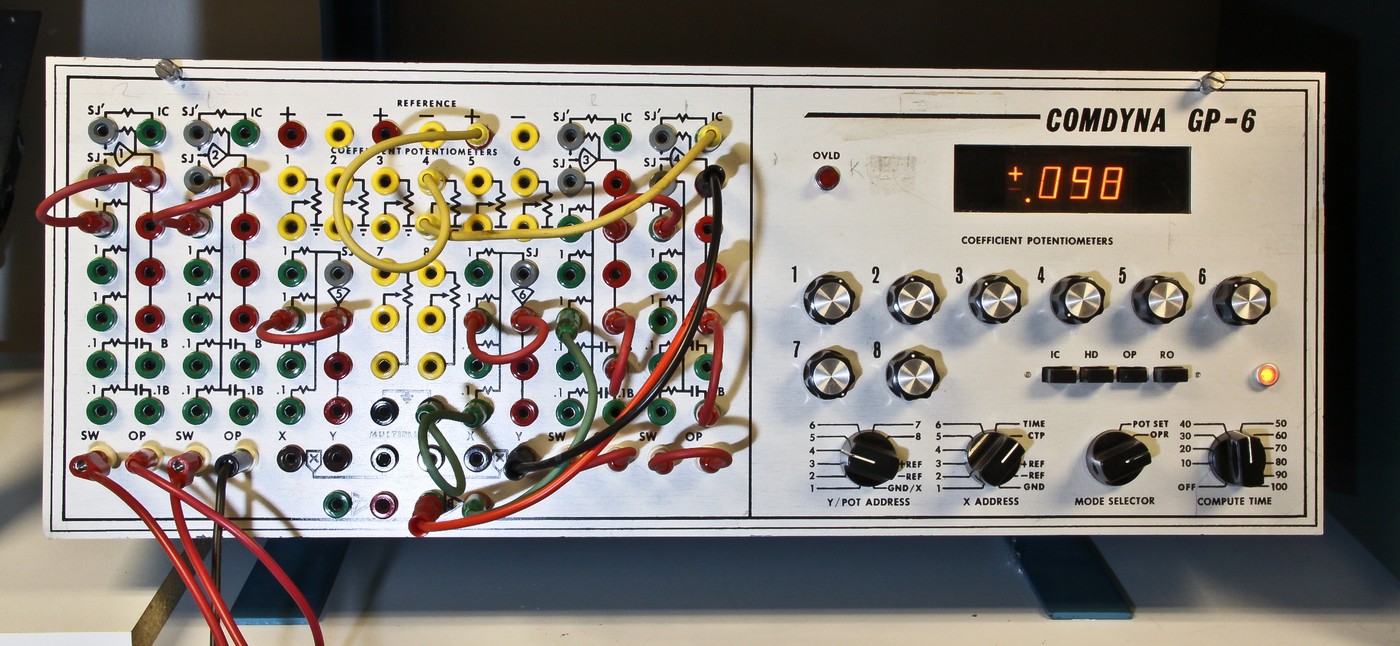
Figure 1 — A Comdyna GP-6, the machine a homebrew builder of the 1970s through the 2000s would have been measured against: eight coefficient potentiometers with a two-axis address scheme, a digital readout, IC/HD/OP/RO mode selection and a compute-time control. Secondary sources give a production span of 1968 to 2004; no primary document establishing either endpoint is held here. Photograph held locally in this project; provenance is unrecorded and is discussed in photo_credits.txt.
7.1 About This Volume
Two closing tasks.
The first is the licence audit promised in Vol 1 §4. Each design in the survey is taken in turn, its licence position stated from the primary document rather than from a description, and the consequence for a later builder spelled out. This is done at length because the phrase “open-source analog computer” circulates widely in this field and, applied carefully, fits very few of the things it is applied to.
The second is the comparison the series has been building toward: where the modern reimplementations genuinely depart from the machines of the 1950s and 1960s, and where they only appear to. Several of the apparent departures dissolve on inspection, and one of the real ones runs in the opposite direction from the one usually assumed.
Cross-references: Vol 1 §4 for the test applied here; Vol 4 for the designs; Vol 2 §6 and Vol 5 §5 for the technical points §4 returns to.
7.2 The Licence Audit
7.2.1 THE ANALOG THING
The strongest position in the field, and the only design in the survey that clearly passes the test.
The anabrid/the-analog-thing repository is licensed BSD 3-Clause, with the copyright line “Copyright (c) 2022, Anabrid GmbH”. The repository contains a licence file, a readme, and a directory of open-source hardware material holding schematic PDFs for the base and front boards, production data directories and packaged production archives.
The project’s own wiki states that “all circuits, documentation and assembly instructions are publicly available under a permissive open source license” and that “if anybody wants to recreate or even sell THATs, this is granted by the open source license”. The licence text is consistent with that statement: BSD 3-Clause permits redistribution and modification in source and binary form, requiring retention of the copyright notice and disclaimer, and forbidding use of the copyright holder’s name to endorse derived products.
Two honest qualifications:
- The hardware is published as PDFs and production data, not as editable design files. A reader can read the schematics and can have the boards fabricated. Modifying the design means redrawing it. Against the Vol 1 §4 test this is a pass on question one, a partial pass on question two, and a clear pass on questions three and four.
- BSD 3-Clause is a software licence. It expresses the intent unambiguously and is far better than silence, but it was not drafted for hardware and does not address the questions hardware-specific licences exist to address.
Neither qualification undermines the position. THAT is open hardware by any reasonable reading, and it is the only machine in this survey of which that can be said plainly.
7.2.2 Analog Paradigm Model-1
The most interesting case, and the one where reading the primary document matters most.
The anabrid/Model-1 repository carries two licence files, LICENSE.GPL3 and LICENSE.ANABRID, and its readme states: “Our software is dual-licensed with GPL3 and a proprietary license for commercial use.” The repository contains application_notes, documentation, software and — significantly — hardware, the last holding directories named for the modules themselves: CMP4, CU, DPT24, HC, INT4, MDS2, MLT8, PS, PT8, SUM8, XBAR and backplanes_etc.
The proprietary half of that dual licence is worth quoting, because paraphrase would misrepresent it. LICENSE.ANABRID, headed “ANABRID LICENSE AGREEMENT, Agreement version 0.0.0”, reads in part:
“This document is a stub. We basically follow the Qt licensing model… And there will be some legal-speaking text at this point.”
and closes:
“In other words, our software is currently double-licensed with GPLv3 and a proprietary license which grants permissions beyond GPLv3 but requires paying some royality fee :-)”
Two observations follow, neither of them a criticism of a company that is plainly acting in good faith and says so cheerfully.
The commercial terms are not determinable from the published documents. A stub is not a licence. A commercial user cannot establish from the repository what they may do or what it would cost.
The licence speaks of software; the repository contains hardware. Every quoted sentence says “software”. The hardware directory sits alongside, covered by nothing that names it. Whether GPL3 is intended to reach the module design files is not stated, and GPL3 applied to hardware raises questions it was not written to answer.
Against the Vol 1 §4 test the Model-1 passes questions one and three and lands ambiguously on question four. A builder studying it is on safe ground; a builder redistributing derived hardware is not, and should ask.
7.2.3 LUCIDAC
Named here because it is anabrid’s current machine and is frequently described as open source, which requires care.
What is published is substantial: lucidac-resources holds the manual, firmware and examples; lucipy, a Python client, and lucidac-firmware are public, the latter two archived; pybrid-computing is the runtime library for the REDAC and LUCIDAC machines. The project states its open-sourced code is available and licensed MIT or GPL.
What is not published, on the evidence of the repositories examined, is the hardware design. lucidac-resources contains documentation, firmware and examples, and carries no licence file. No schematic or board data for LUCIDAC appears in the public repositories.
The accurate statement is therefore: LUCIDAC’s software stack is open source; LUCIDAC is not, on published evidence, open hardware. That is an entirely ordinary commercial position and a different claim from the one made for THAT.
7.2.4 The anabrid hardware Repository
A one-line illustration of the whole problem. Its readme reads: “The hardware repository holds assorted bits and pieces of hardware we want to release to the community. :-)” It contains a readme, a prototyping-boards directory and a the-analog-thing directory.
It has no licence file at all. The intent to release is stated in words; the instrument that would effect it is absent. Vol 1 §4 called this combination — intent without instrument — characteristic of the field, and here it is in a single repository.
7.2.5 The Personal Repositories
Table 1 — The Personal Repositories
| Repository | Licence | Assessment |
|---|---|---|
danja/analog-computer | MIT | Passes the licence test. Contains design notes, front-panel design, SPICE work and a development log; the machine itself is unbuilt, so what is licensed is a design in progress |
Marbslab/Analog-computer | MIT | Passes the licence test and is the most reproducible thing in the survey — Gerbers, bill of materials and printed mechanical parts are all present — while being among the least explicable, with essentially no written documentation |
PrasannahRam/ANALOG_COMPUTER | None | Published, not licensed |
The middle row is the most instructive in the whole audit. A permissive licence plus fabrication files plus no explanation produces a design that can be legally and physically reproduced by someone who cannot understand it. The magazine series of Vol 4 produce the opposite. Neither is complete, and a reader wanting both must currently take the explanation from 1978 and the files from 2024.
7.2.6 Fitch, 2010
Nothing in the panel artwork, the three schematic sheets, the bill of materials or the project page states any licence terms. The material is published — it was put on a public website to be read — and it is not licensed.
This is not a defect in the work. It is the ordinary state of a designer sharing a project in 2010, before public version control and licence files became the default for hardware. The consequence for a later builder is nevertheless real, and it is why this series reproduces the drawings as editorial reference, says so in photo_credits.txt, and recommends that anyone wishing to reuse them ask the designer.
7.2.7 The Magazine Designs and the Vogel Boards
The 1968 PEAC series and the 1978 Kronis series are the property of their publisher; the library record for the 1978 series carries the credit “IPC Magazines Limited, 1978”. They are historically important, thoroughly documented, and not free to redistribute.
The Vogel design circulated as printed circuit boards distributed by the designer, with a published account of one build. No public licence is held.
7.2.8 The Audit in One Table
Table 2 — The Audit in One Table
| Design | Files published | Editable source | Licence file | Covers hardware | Verdict |
|---|---|---|---|---|---|
| THE ANALOG THING | Yes | Partial — PDFs and production data | BSD-3-Clause | Software licence, hardware intent explicit | Open hardware |
| Analog Paradigm Model-1 | Yes | Partial | GPL3 + stub | Licence text names software only | Ambiguous |
| LUCIDAC | Software only | n/a | Software repos licensed | No hardware files published | Open software, closed hardware |
danja/analog-computer | Yes | Yes | MIT | Software licence | Licensed, incomplete |
Marbslab/Analog-computer | Yes | Gerbers, not sources | MIT | Software licence | Licensed, unexplained |
PrasannahRam/ANALOG_COMPUTER | Yes | Partial | None | — | Published only |
| Fitch 2010 | Yes | No — PDFs | None | — | Published only |
| EEVblog machine | Partially, in thread | No | None | — | Published only |
| Vogel | Boards, by the designer | No | None | — | Circulated only |
| PEAC 1968, Kronis 1978 | Yes, in print | No | Publisher’s copyright | — | Copyrighted |
Three of ten carry a licence that clearly permits reuse. One of ten is unambiguously open hardware. That is the state of the field, and it is the central finding of this series.
7.3 Where the Modern Machines Genuinely Depart
7.3.1 The Multiplier Stopped Being a Subsystem
The clearest real departure. In 1968 PEAC devoted an entire optional unit to a four-quadrant multiplier. The commercial machines of the period used quarter-square networks of matched diodes, or, earlier, servo-driven potentiometers — an electromechanical assembly per multiplication.
Today the same function is one eight-pin package requiring no external components, laser-trimmed to a guaranteed 2 % of full scale (Vol 2 §6.1). An element that was a project in its own right is now cheaper than the socket it sits in, and that single change is why non-linear problems are routine on homebrew machines rather than aspirational.
7.3.2 The Machine Unit Fell, and the Reason Is Not Accuracy
Every machine in this survey except one uses ±10 V. The 1950s and 1960s machines used more: ±100 V on the large EAI installations, ±60 V on the Heathkit EC-1.
The reason for the fall is integrated circuits. A monolithic op-amp runs from supplies of roughly ±15 V and cannot swing to ±100 V, so the machine unit dropped to what the available amplifiers could deliver. This was a consequence of the parts, not an improvement in computing practice — and, as §4.3 notes, it cost something.
7.3.3 Solid-State Mode Switching
Relays were universal; CMOS analog switches are now an option, bringing microsecond transitions and no wear at the cost of charge injection and leakage (Vol 3 §3). This is a genuine widening of the design space rather than a straightforward improvement, and Vol 3 §3.3 gives the conditions under which each is correct.
7.3.4 The Readout Became Part of the Machine
The 1960s machine had a panel meter, a null potentiometer and an oscilloscope beside it. Marbslab’s repository contains an STL file for a DSO138 oscilloscope enclosure as part of the machine’s structure. An inexpensive scope module is now cheap enough to design into the chassis, which changes the experience of using the machine more than its specification suggests.
7.3.5 Hybrid Operation Became Ordinary
THAT provides a hybrid port and anabrid publishes an Arduino-based hybrid controller for it; the Malmö thesis treats the analog machine explicitly as a co-processor for a digital host. Hybrid computing existed in the 1960s — EAI’s HYDAC systems are in this project’s library — but it was a large-installation capability. It is now a header on a €499 desktop machine.
7.3.6 The Publication Model Changed, and Not Only for the Better
A 1978 constructional series explained its circuits, its construction, its testing and its programming across four issues, and published a correction when it got a diagram wrong. A 2024 repository publishes files. Vol 4 §9 observed that a reader wanting to understand an analog computer is better served by 1978 than by 2024. That is a real departure and it runs backwards.
7.3.7 The Reconfigurable Connection Matrix
The one architectural departure that is genuinely new. Anabrid describes LUCIDAC as having a digitally programmable all-to-all analog connection matrix with sixteen inputs and sixteen outputs, alongside eight integrators, four multipliers, coefficients, ADC and DAC channels and a microcontroller with network connectivity.
This replaces the patch field with a switch matrix under software control. If the patch field is the program (Vol 5 §6.4), then a program becomes a data structure that can be stored, version-controlled, generated and swept — which addresses the single largest practical complaint about analog computing, that the program lives only in a tangle of wire.
What is given up is the thing every account of analog computing reaches for: the physical, visible, tactile correspondence between the wiring and the equation. Whether that is a loss or merely nostalgia is a matter of judgement, and this series does not need to settle it.
7.4 Where They Only Appear to Depart
7.4.1 The Element Set Has Not Changed
Summer, integrator, coefficient potentiometer, multiplier, comparator, reference. The list is the same in the 1956 texts, in the 1968 magazine series and in a 2026 machine. The implementations changed completely and the abstraction did not move at all. Vol 2 is, in this respect, a volume that could have been written seventy years ago.
7.4.2 Patching and Scaling Practice Has Not Changed
Every step of the procedure in Vol 6 — solve for the highest derivative, estimate the maxima, choose scale factors, realise coefficients as pot times weight, resolve the signs, choose the time scale, check statically — is the practice described in the 1960s manuals. A programmer trained on an EAI machine would need no retraining on a modern one.
7.4.3 Accuracy Has Not Demonstrably Improved for Homebrew Machines
This is the uncomfortable one. Modern parts are enormously better than 1960s parts: an OP07’s 75 µV maximum offset against a drifting vacuum-tube amplifier is not a close comparison.
But Vol 1 §6 and Vol 4 §9 established that no homebrew design in this survey reports a measured error against a known solution, across five decades. There is therefore no evidence, in the material held here, that modern homebrew machines are more accurate than their predecessors. They are certainly built from better components. What was done with that advantage is unmeasured, and several of the designs — the ones built to draw attractors rather than produce numbers — deliberately did not pursue it.
7.4.4 The Highest-Precision Machine in the Survey Is the Most Old-Fashioned
The EEVblog machine of Vol 4 §7 sets its machine unit at ±100 V on ±110 V rails, explicitly to reduce the relative significance of offsets and diode drops. That is the 1950s professional convention, revived deliberately in 2012 against the modern ±10 V norm, by the only builder in the survey whose stated primary goal is precision.
This is the cleanest available counter-example to the assumption that the modern reimplementations are improvements on the old machines. On the one axis the old machines optimised for, the modern norm is a regression, and the builder who cared most about that axis went back.
7.5 Why the Revival Happened
The modern designs in this survey cluster after 2020, and the reason they give is consistent.
The Malmö thesis (Vol 4 §6) argues that digital computing’s energy consumption has become the binding constraint, that a hybrid system using an analog co-processor for differential equations can be faster and more efficient, and that for this to matter analog computing “must be made accessible to a wider group of people compared to today”. Charles Platt’s 2023 WIRED feature, held in this project’s library, surveys the same argument through researchers at Mythic, IBM, Columbia and MIT, and concludes that the energy demands of AI workloads are the primary driver.
The educational thread is the older one and has not gone away. Platt’s 2022 Make article introduces analog computing through a three-potentiometer project derived from the 1961 General Electric EF-140 kit — a machine this hub covers separately, and which, as that dive establishes, is not an operational-amplifier machine at all. THAT is sold as an educational instrument and is explicitly not-for-profit.
Both threads point the same way for a homebrew builder: the reason to build one of these machines is that building it teaches the mathematics, the analog electronics and the discipline of scaling in a way that reading cannot. Every design in Vol 1 §5 was built by somebody who wanted to understand something.
7.6 Open Questions
Carried from the whole series, unresolved:
- Was the EEVblog machine completed? The surveyed portion of the thread shows boards in layout and parts being procured in early 2013. Nothing held here establishes the outcome, and it is the machine whose completion would be most interesting.
- Which revision do Fitch’s documents describe? The project page reports the drawings untested, with two board errors known, and separately reports a working Lorenz attractor. Both statements are credible; they are not reconciled by anything held here.
- The Fitch device count. The bill of materials lists three TL074J; the schematic sheets appear to require four. The separate-board explanation is plausible and remains inference (Vol 4 §5.4).
- What the Model-1’s commercial licence actually requires. The document is a stub by its own admission.
- Whether any of these machines was ever measured. No accuracy figure for any homebrew machine in this survey has been found. A single careful measurement of one of them against an analytic solution would be the most valuable addition to this record.
- Comdyna’s production span. 1968 to 2004 is given by secondary sources only.
- Whether a Eurorack-format computing module set exists as a coherent published design. Vol 5 §3.5 concluded it would be a good decision; no instance of anyone having done it was found.
7.7 Closing
The field surveyed here is small, unevenly documented, and much less open than its own vocabulary suggests. Three designs of ten carry a licence permitting reuse; one is unambiguously open hardware. Nobody measures anything. The best-explained machines are fifty years old and the best-licensed one is five.
What the record does contain, consistently, is people building a machine in order to understand something — a chaotic circuit, a control system, a thesis argument about energy, or simply what an integrator does when you put your hand on the coefficient knob while it runs. The element set has not changed since the 1950s and the practice of using it has not changed either, which means the 1968 articles are still the best introduction available and a machine built from a 2026 repository will be programmed exactly as its ancestors were.
For a builder starting now, the series’ recommendation is unromantic: build eight elements, not twenty; put a balance control on every amplifier and an overload detector on every output; keep the summing junctions short and the patch diagrams filed; measure the machine against a known solution before trusting it on an unknown one; and publish the result with a licence file in it.
Comments (0)