Homebrew / Open-Source · Volume 1
Homebrew & Open-Source Analog Computers — Volume 1 — Scope, definitions and the state of the field
What counts as a homebrew machine, what 'open-source' actually means once the licence is read, and a census of the designs a builder can work from today
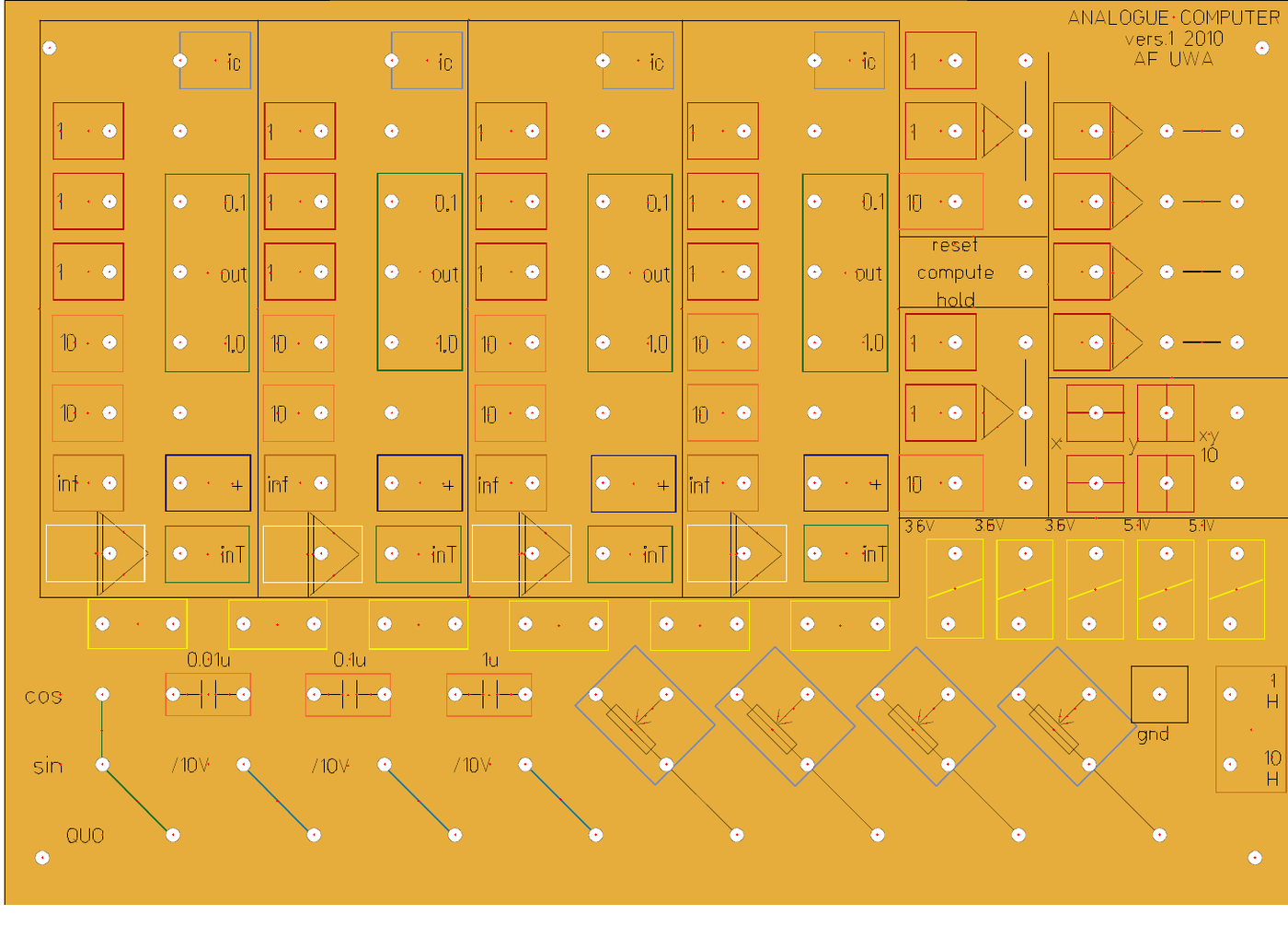
Figure 1 — The panel artwork for Andrew Fitch’s 2010 “Analogue Computer”, carrying the designer’s own annotation “vers.1 2010 AF UWA”. Four summer/integrator columns occupy the left two-thirds; the reset/compute/hold control and the inverter and multiplier blocks sit at the right; free zener and signal diodes, free capacitors, potentiometers and a sine/cosine generator fill the lower strip. Panel drawing from ACpanel.pdf, held locally in this project; provenance recorded in photo_credits.txt.
1.1 About This Volume
This series is not about one machine. Every other deep dive in this hub — the Heathkit EC-1, the Heathkit ES-400, THE Analog Thing, the EAI PACE TR-10, the GE EF-140 — takes a single manufactured product and works outward from its documentation. This one takes a practice: the building of electronic analog computers by people who are not a manufacturer, and the publication of those designs in a form somebody else can use.
That difference forces a boundary to be drawn explicitly and then held, because a survey without a boundary becomes a list of everything anyone has ever called an analog computer. Section 2 draws it. Sections 3 and 4 do the harder definitional work, which concerns the second half of the title rather than the first: “open-source” is a claim about a licence, and in this field the claim is made far more often than the licence exists. Section 5 is the census — what a builder in 2026 can actually obtain and work from. Section 6 states what is not known.
A reader who wants circuit theory should go straight to Vol 2. A reader who wants to build something should read Vol 2, Vol 3 and Vol 5 and treat this volume as orientation.
1.1.1 Depth-Index: The Seven-Volume Series
Table 1 — Depth-Index: The Seven-Volume Series
| Vol | Title | Primary content |
|---|---|---|
| 1 | Scope, definitions and the state of the field (this volume) | The boundary, the two definitions, the licence test, the census of extant designs, what is not known |
| 2 | The computing elements | Op-amp as computing element; summer, inverter, integrator, coefficient pot, multiplier, comparator; the error terms that matter and the parts that meet them |
| 3 | Integrators, mode control and what is genuinely hard | IC/OP/HLT, relays against analog switches, capacitor dielectrics, drift budgets, overload detection, coefficient setting and readout |
| 4 | The documented designs, read as engineering | PEAC (1968), Kronis (1978), Fitch (2010), Malmö (2022), the EEVblog ±100 V machine, the GitHub repositories — each read for what it decided and why |
| 5 | Substrates and physical construction | Eurorack, Synthesizers.com, Eurocard/DIN 41612, single-board and hand-wired chassis; jacks, panels, power, mechanical practice |
| 6 | Patching and scaling practice | Amplitude and time scaling from first principles, worked programs, static check-out, troubleshooting a machine that is lying to you |
| 7 | Licences, provenance, and where the modern machines depart | The licence audit in full; how modern reimplementations differ from the 1960s machines and why; open questions |
Note — Cross-references appear throughout as “see Vol N §M”. Each volume is self-contained; this one assumes no other volume has been read.
1.2 The Boundary
1.2.1 What This Series Covers
The subject is the electronic, patch-programmed, general-purpose analog computer built outside a production line — either by an individual working from a published design, or by an individual publishing a design for others. Both halves matter. A machine built once and never documented is not recoverable by anybody else, and a design published but never built is not evidence that it works.
Four tests are applied. A thing belongs in this series when it is:
- Electronic and operational-amplifier-based. Voltages represent variables; amplifiers with resistive or capacitive feedback perform the arithmetic.
- Patch-programmed and general-purpose. The program is a wiring pattern the operator changes, not a fixed function the designer chose.
- Built or buildable outside a factory. Either the machine was assembled by an individual, or the design was published in enough detail for an individual to assemble it.
- Documented well enough to be checked. A photograph of a finished machine is not a design. A schematic, a board, a parts list or a constructional article is.
1.2.2 What This Series Excludes, and Why
Table 2 — What This Series Excludes, and Why
| Excluded | Reason |
|---|---|
| Mechanical analog computers — differential analysers, tide predictors, planimeters | A different technology with a different literature. They belong to the prehistory of this subject and are mentioned only where a modern builder cites them |
| Commercially manufactured machines | The EC-1, ES-400, TR-10, EF-140 and Comdyna GP-6 are reference points here, not subjects. Each has, or will have, its own treatment |
| Analog AI accelerators and in-memory-compute chips | These are analog and they are current, but they are not patch-programmed and not general-purpose. They appear in Vol 7 only to explain why funded interest returned to the field |
| Synthesiser modules used as synthesisers | Function-generating modules that happen to integrate are not an analog computer. Vol 5 treats the harder question of whether they can be assembled into one |
| THE Analog Thing, as a subject | Covered separately and in depth — see below |
1.2.3 THE Analog Thing Is a Reference Point Here, Not the Subject
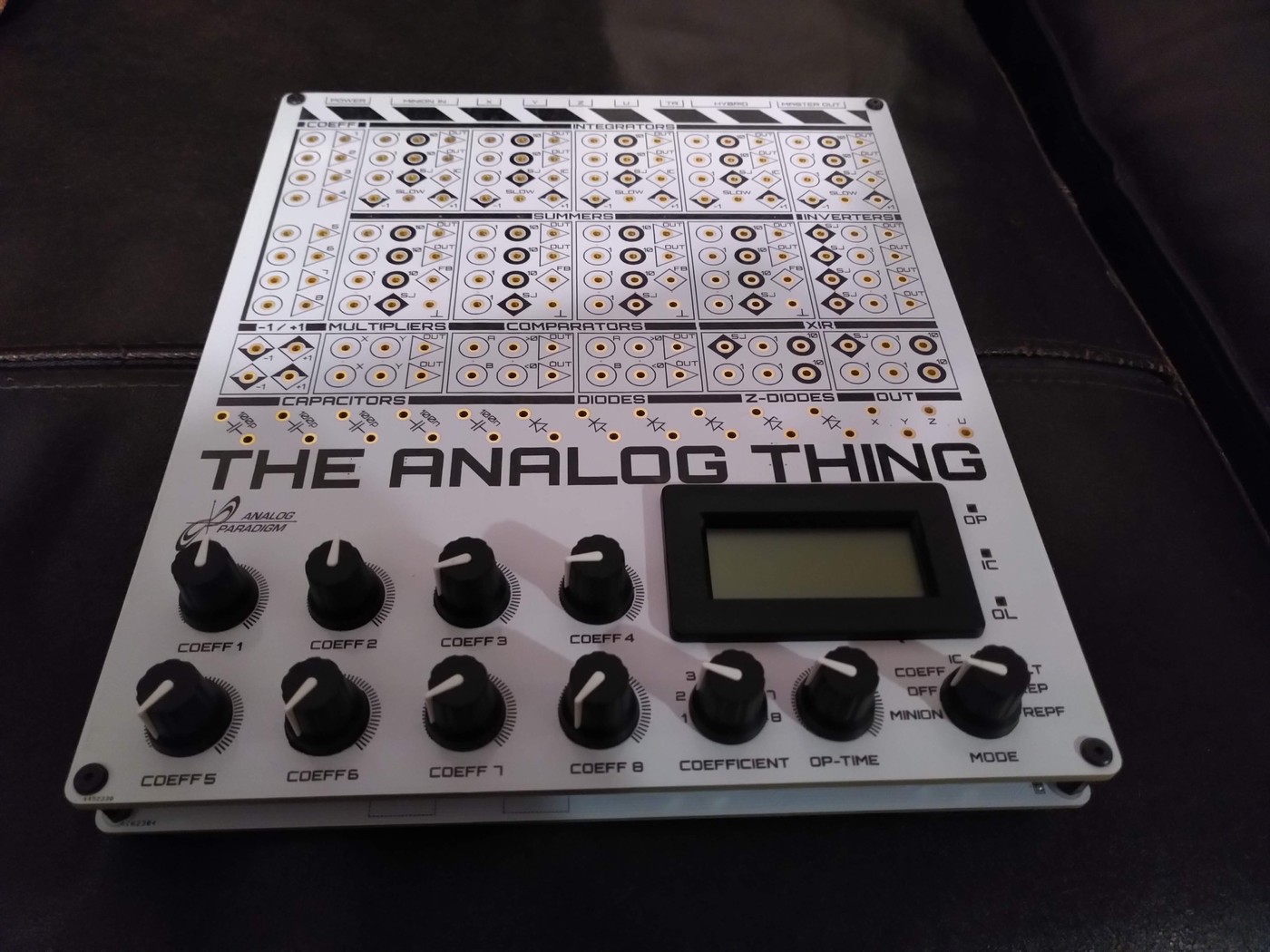
Figure 2 — THE ANALOG THING, the machine against which every design in this series is measured. The printed patch field carries the element symbols directly; the eight coefficient potentiometers and the IC/OP/HLT mode switch occupy the lower panel. Photograph: File:THE ANALOG THING.jpg by Jwdietrich2, CC BY 4.0, via Wikimedia Commons.
THAT already has an eight-volume treatment in this hub, and nothing here duplicates it. It appears in this series for one reason: it is the only machine in the field that passes the full open-hardware test in §4 while also being a finished, purchasable product, which makes it the natural yardstick. Where a homebrew design makes a decision, the useful question is usually “what did THAT do, and why is this different?”
Three facts about it are carried forward and used throughout. Its schematics and production data are published by anabrid GmbH in a public repository under the BSD 3-Clause licence, copyright notice dated 2022. It is sold assembled at €499, which sets the price a homebrew machine has to beat or justify. And its computing complement — five integrators, four summers, four inverters, two multipliers, two comparators and eight coefficient potentiometers, on ±12 V rails with ±10 V as the machine unit — is a concrete answer to “how many of each element is enough”, which Vol 2 §6 uses as a baseline.
1.3 The First Word: “Homebrew”
The term does less work than it appears to. It describes who built a machine, not how good it is, and the record contains homebrew machines that outperform contemporary commercial ones as well as machines that barely work.
What the homebrew designs in this series do have in common is a set of constraints the manufacturers did not share:
Table 3 — What the homebrew designs in this series do have in common is a set of constraints the manufacturers did not share
| Constraint | Consequence visible in the designs |
|---|---|
| No calibration laboratory | Accuracy is claimed rarely and measured even more rarely. Most published homebrew designs state no accuracy figure at all |
| No production volume | Parts are whatever was cheap and available in single quantities, which is why the same three or four part numbers recur across decades |
| One person’s labour | Element counts are small. Ten amplifiers is a large homebrew machine; the 1960s professional machines had ten times that |
| No obligation to support it | Documentation stops when the builder’s interest does, which is the single commonest defect in the record |
| Freedom to be strange | Gyrators for Chua oscillators, ±100 V rails, quadrature oscillators built into the panel — features no manufacturer would ship |
That last row is worth holding onto. The homebrew record’s value is not that it reproduces the commercial machines more cheaply. It is that it contains decisions a product manager would have vetoed, and those decisions are where the engineering interest lies. Vol 4 reads six of them in detail.
1.4 The Second Word: “Open-Source”
1.4.1 The Test
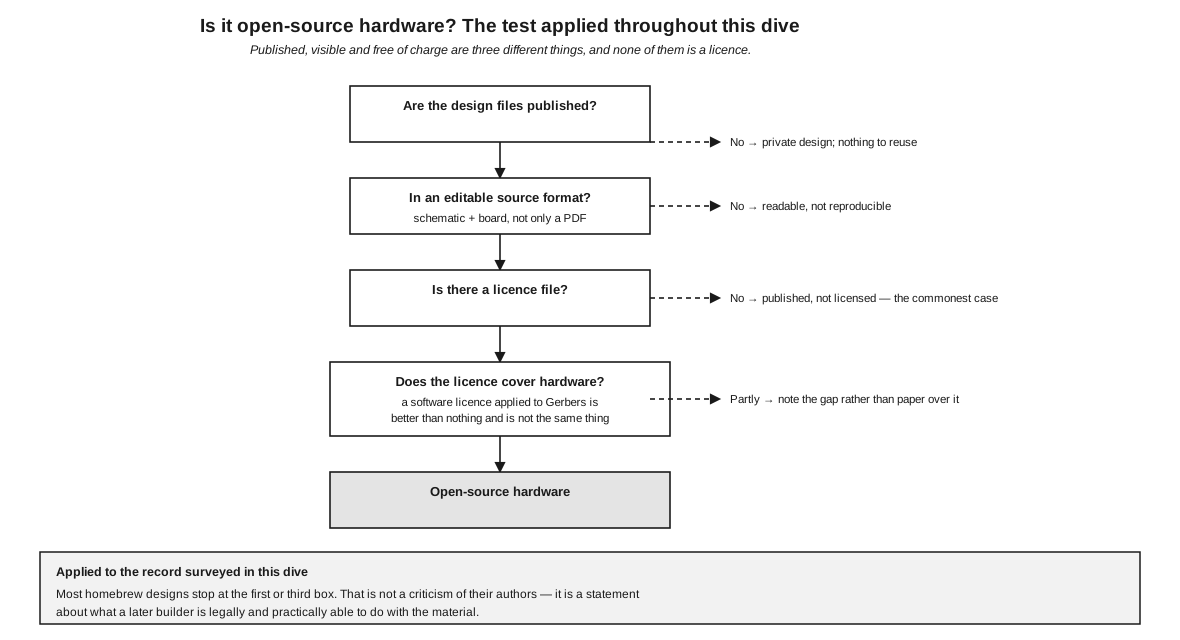
Figure 3 — The test applied to every design in this series before it is described as open hardware. Each “no” exit is a real category with real consequences for a later builder. Diagram authored for this dive by build/make_diagrams.py.
The phrase “open-source analog computer” appears throughout this field, applied to projects at every point on the spectrum from fully licensed to merely visible. This series does not repeat the phrase on a project’s own authority. It applies the four questions in Figure 3, in order, and reports where each design stops.
The distinctions the test enforces are not pedantic:
- Published is not licensed. A schematic on a personal website, with no licence, is readable by anyone and reusable by nobody with certainty. Copyright subsists automatically; silence is not permission. This is the commonest state in the homebrew record and it is not a criticism of the authors, who were sharing work, not drafting instruments.
- A PDF is not a source format. A schematic rendered to PDF can be read and cannot be modified, re-simulated or re-spun. Gerbers can be fabricated but not edited. Neither is equivalent to the design files.
- A software licence on hardware files is a real but partial answer. BSD-3-Clause and MIT were drafted for source code. Applied to Gerbers and schematics they express clear intent and are far better than silence, but they do not address the questions hardware-specific licences were written for. This is worth stating plainly because the best-licensed projects in this field — including THAT — are in exactly this position.
1.4.2 What the Test Returns
Applied across the field, the answers cluster in a way that is itself the finding:
Table 4 — Applied across the field, the answers cluster in a way that is itself the finding
| Category | Examples in this survey | What a later builder can do |
|---|---|---|
| Licensed, hardware files published in source form | THAT (BSD-3-Clause) | Rebuild, modify, sell — the licence says so |
| Licensed software, hardware published, licence stub incomplete | Analog Paradigm Model-1 | Ambiguous; see Vol 7 §3 |
| MIT-licensed personal projects | danja/analog-computer, Marbslab/Analog-computer | Reuse permitted; completeness varies sharply |
| Published without any licence | Fitch (2010), the EEVblog machine, most magazine designs | Read and learn; reuse at the reader’s own legal assessment |
| Published as a magazine article under a publisher’s copyright | PEAC (1968), Kronis (1978) | Historically important, legally still someone’s property |
One further case deserves naming because it is easy to misread. The anabrid hardware repository is described by its own README as holding “assorted bits and pieces of hardware we want to release to the community” — and carries no licence file at all. The intent is unmistakable and the legal instrument is absent. That combination, intent without instrument, characterises a great deal of this field.
1.5 The Census: What Actually Exists
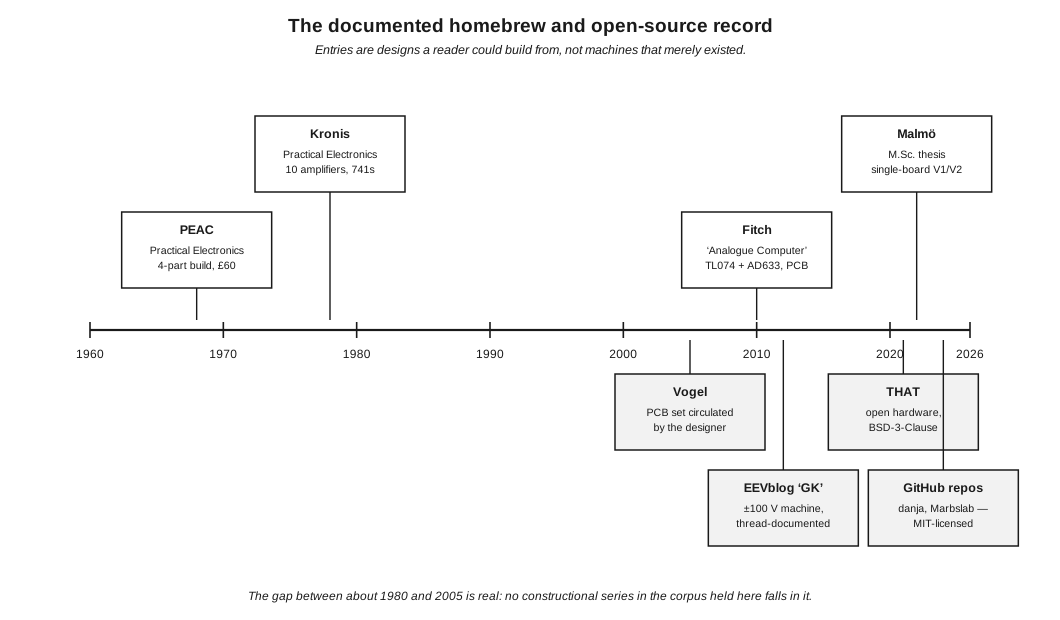
Figure 4 — The documented record held in this project. Entries are designs a reader could build from, not machines that merely existed. Diagram authored for this dive by build/make_diagrams.py.
1.5.1 The Designs
Table 5 — The Designs
| Design | Date | Elements | Key parts | Licence status |
|---|---|---|---|---|
| PEAC, Practical Electronics | 1968 | Modular units A–D; amplifiers, integrators, function generator, four-quadrant multiplier | Silicon transistors; discrete | Publisher’s copyright |
| Kronis, Practical Electronics | 1978 | Ten computing amplifiers; 148-socket patch panel | 741 op-amps; two AD533JD multipliers; relay mode control | Publisher’s copyright |
| Vogel homebrew | c. 2005 | Compact desktop machine, 2 mm jacks | LF355/LF353 in the original; AD534K multiplier | PCBs circulated by the designer; no public licence |
| Fitch, “Analogue Computer” | 2010 | 4 summer/integrators, 2 summers, 4 inverters, 2 multipliers, gyrators, quadrature oscillator | TL074J; AD633JN; DPDT relays; µA78M12CKC | Published, no licence stated |
| EEVblog “GK” | 2012 onward | Function generators, log/antilog amplifiers, iteration counter; 19-inch rack | LT1097; SSM2212; ±110 V rails | Thread-documented; no licence |
| THE Analog Thing | 2021 | 5 integrators, 4 summers, 4 inverters, 2 multipliers, 2 comparators, 8 pots | TL074H; ±12 V rails | BSD-3-Clause |
| Malmö thesis machine | 2022 | Single-board V1 and V2; second-order capability | TL074; AD633JNZ; NJU7662 | Thesis; no hardware licence |
danja/analog-computer | 2020–2026 | Summers, integrators, differentiators; 2 mm patch field | Op-amps, breadboard prototype | MIT |
Marbslab/Analog-computer | 2024–2026 | Single board, with Gerbers, BOM and printed parts | Not fully documented in the repository | MIT |
1.5.2 Three Observations From the Table
The parts list barely changes. A TL07x-family quad op-amp and an AD633 multiplier appear in designs forty years apart and in machines at both ends of the quality range. Vol 2 §4 examines whether that persistence is justified by the parts or merely by their familiarity; the answer is not the same for the two chips.
The gap is real. The corpus held in this project contains no constructional series between about 1980 and 2005. That is not proof nobody built anything, but it matches the wider history: the analog computer stopped being a thing a magazine would serialise at roughly the point the microcomputer became one.
Completeness and licensing are uncorrelated. The two MIT-licensed repositories are among the least complete designs in the table. The most thoroughly engineered homebrew machine in it — the EEVblog ±100 V system, which is the only entry to treat precision as its primary design goal — has no licence at all. A licence tells a reader what they may do, not whether the thing works.
1.5.3 What a Machine Has To Contain
Every design in the table converges on the same irreducible element set, which is the subject of Vol 2:
Table 6 — Every design in the table converges on the same irreducible element set, which is the subject of Vol 2
| Element | Function | Minimum useful count |
|---|---|---|
| Summer / inverter | Weighted addition and sign change | 2–4 |
| Integrator | Integration with respect to machine time, with settable initial condition | 2 for any second-order system; 3 for the interesting non-linear ones |
| Coefficient potentiometer | Multiplication by a constant between 0 and 1 | One per coefficient in the equation |
| Four-quadrant multiplier | Multiplication of two variables | 0 for linear work; 2 for Lorenz-class problems |
| Reference | Defines the machine unit against which everything else is measured | 1, and its quality sets the machine’s absolute accuracy |
| Mode control | IC / OP / HLT applied to every integrator simultaneously | 1, and it is the hardest part to build well — Vol 3 |
1.6 What Is Not Known
Stated plainly, so that no later volume has to imply otherwise:
- Measured accuracy for any homebrew design in the table. Not one of the constructional articles surveyed reports a measured error figure for a completed machine against a known solution. Claims about homebrew accuracy in this series are therefore derived from component specifications, and are labelled as derivations wherever they appear.
- How many were built. No design in the table has a known build count. The magazine series presumably produced machines in some quantity; no evidence of that is held here.
- Whether the Fitch machine was finished as documented. The held page states that the schematics and panel were, at the time of writing, untested, and separately reports a working Lorenz attractor afterwards. The two statements are consistent with a working machine but do not establish which revision the photographs show. Vol 4 §4 sets out exactly what the documents support.
- The Model-1 licence. The proprietary half of anabrid’s dual licence is, in the repository text itself, explicitly “a stub”. What a commercial user may do is therefore not determinable from the published documents. Vol 7 §3 quotes the text rather than paraphrasing it.
- Comdyna’s production span. Secondary sources give 1968–2004 for the GP-6. No primary document establishing either endpoint is held here, and the figure is used only as background.
1.7 Why This Subject Is Worth Seven Volumes
The element set is small enough to hold in the head and rich enough to be hard. Six kinds of component, one of which — the integrator with its mode switch — contains nearly all the difficulty. That ratio is unusual and it is what makes the machine a good teacher.
The failure modes are instructive rather than merely annoying. An analog computer that is wrong does not halt or throw. It produces a smooth, plausible, continuous curve that is not the solution. Learning to distrust a good-looking answer, and to build the static checks that catch it, is a transferable discipline. Vol 6 §5 treats it as a procedure.
The licensing question is live and generalises. The gap between “published” and “open” documented here is not specific to analog computers. It is the ordinary state of most shared hardware, and the four-question test in §4 applies unchanged to anything else a reader might want to build from someone’s published design.
1.8 What Comes Next
Vol 2 takes the element set apart: what an operational amplifier has to do to be a computing element, which error terms matter, and which specific parts meet the requirement — with every figure traced to a datasheet rather than to habit. Vol 3 goes to the integrator and its mode switch, which is where homebrew machines are won and lost. Vol 4 reads the six documented designs as engineering decisions. Vol 5 covers substrates and physical construction, including the recurring question of whether a Eurorack case can be made into an analog computer. Vol 6 is programming: scaling, worked patches and check-out. Vol 7 is the licence audit and the account of where the modern machines depart from the 1960s ones, and why.
Comments (0)