GE Project EF-140 · Volume 7
GE Project: Analog Computer EF-140 — Volume 7 — Analog computing principles
What this machine embodies, what it cannot do, why the integrator is the dividing line, and whether General Electric was entitled to the name
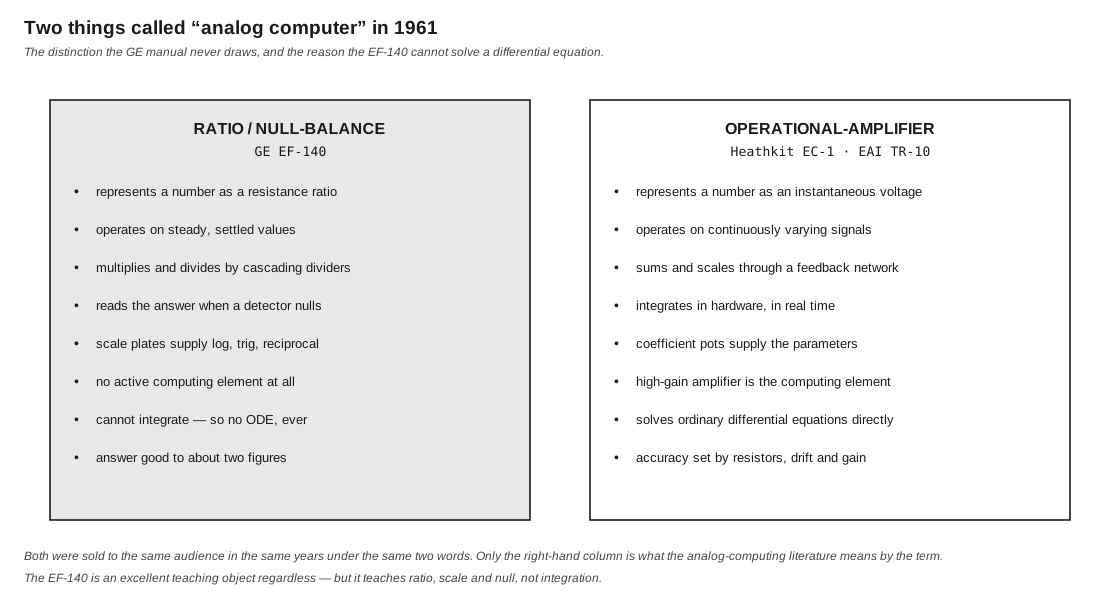
Figure 1 — Two things called “analog computer” in 1961. Diagram authored for this dive; the distinction is this series’ argument, not a claim from the source.
7.1 About this Volume
Six volumes have described a machine: three potentiometers, a bridge, an audible null, a set of printed cards, and forty-nine problems. This volume asks what that adds up to.
The question is not pedantic. General Electric sold this kit as an analog computer in the same years and to an overlapping audience as the Heathkit EC-1 and the EAI PACE TR-10, and the three machines have almost nothing in common beyond the words on the box. A reader who takes the EF-140 as a small example of what the other two do will misunderstand all three.
The conclusion reached here is that the EF-140 is a real analog computing device belonging to a different and older tradition than the operational-amplifier machines — and that it is, by a clear margin, the best teaching object of the three for the things it actually teaches.
Cross-references: Vol 2 for the circuit this argument rests on; Vol 5 for the scales; Vol 6 §6.2 for what the problem set reveals about the machine’s role.
7.2 What “Analog” Means
7.2.1 The Manual’s Definition
General Electric’s Part 1 is careful and correct:
“A digital computer counts, like a man counting on his fingers. It adds, subtracts, divides and multiplies by counting. However, the ‘fingers’ it counts are pulses of electricity…
Analog computers, on the other hand, work by comparing physical quantities. For instance, in the computer you will build and in all analog computers built today, numbers are multiplied by multiplying electric currents.”
And in Part 4, more precisely: “They compare physical quantities.”
By this definition the EF-140 unambiguously qualifies. A number is represented by a continuous physical quantity — the position of a wiper, and thereby a voltage ratio. Numbers are combined by a physical process — the cascading of two voltage dividers. The answer is obtained by comparing two such quantities. Nothing is counted anywhere in the machine.
7.2.2 The Narrower Definition
The trouble is that by 1961 the phrase “analog computer” had acquired a much narrower technical meaning in engineering practice. In the literature of the period — Korn and Korn’s Electronic Analog Computers, Johnson’s Analog Computer Techniques, and the manufacturers’ own documentation — an analog computer is a machine that solves differential equations by interconnecting high-gain operational amplifiers configured as summers and integrators.
That is what the Heathkit EC-1 is, and what the EAI TR-10 is. It is not what the EF-140 is.
Both definitions were current simultaneously. Neither is wrong. But they pick out different machines, and the gap between them is the subject of this volume.
7.3 What the EF-140 Genuinely Embodies
Four principles, all of them real analog computing, all of them well demonstrated by this machine.
7.3.1 Continuous Representation
A quantity is a dial position — a continuum, not a set of digits. There is no quantisation anywhere in the machine, and no smallest representable difference except the one imposed by the operator’s eye. This is the foundational idea of analog computation and the EF-140 exhibits it as purely as anything could.
7.3.2 Computation by Physical Law
The product k_X · k_Y is not calculated. It is what a voltage divider fed from another voltage divider does, by Ohm’s law, instantly and without being asked. The machine does not implement multiplication; multiplication is a property of the circuit.
This is the deepest idea in analog computing, and the EF-140 demonstrates it with unusual clarity precisely because the circuit is so small. On a twenty-amplifier TR-10 the same principle is present but buried; here it is two resistive dividers in series and a student can see the whole of it.
7.3.3 The Null Method
Vol 2 §6.2 made the argument: at balance the detector draws no current, so the detector’s properties drop out of the answer entirely — as do the battery voltage and the absolute resistance of every potentiometer. The result depends only on three mechanical positions.
This is a genuinely important measurement technique, it is the basis of the Wheatstone bridge and of potentiometric instruments generally, and a student who understands why silence gives a better answer than a meter reading has learned something that transfers directly to real laboratory practice.
7.3.4 Scaling
Every quantity must be mapped into the range 0 to 1, and the magnitude carried separately by the operator (Vol 5 §2). This is exactly the discipline an operational-amplifier machine imposes, where every variable must be scaled into ±10 V or ±60 V and the scale factors divided out afterwards.
The EF-140 teaches this as thoroughly as any machine could, because it is unforgiving: a number that does not fit the dial simply cannot be entered.
7.4 What It Cannot Do
7.4.1 The Absences
Table 1 — 4.1 The Absences
| Missing | Consequence |
|---|---|
| Any amplifier in the signal path | no gain; no active computing element |
| A summing junction | the machine cannot add |
| Feedback around an active element | no implicit or inverse function solving |
| An integrator | no rate, no time, no differential equation |
| A patch panel | the interconnection is fixed at assembly, permanently |
| A time axis of any kind | one steady answer, read at balance |
The first three are limitations of degree. A machine that cannot add is inconvenient, and Vol 6 §6.2 showed how much paper work that pushes onto the student, but addition can be done by hand.
The fourth is a limitation of kind, and it is the one that matters.
7.4.2 Why the Integrator Is the Dividing Line
An operational-amplifier analog computer earns its name by doing something no amount of hand arithmetic can practically replace: it solves differential equations in hardware, continuously, in real time. A capacitor in a feedback path integrates exactly, by physics, at the speed the problem unfolds. Wire a few of them together in the pattern of an equation and the machine’s voltages evolve as the equation’s variables do — not approximately, not step by step, but as a direct physical analogue.
That capability is the whole reason the machines existed. It is why aerospace companies bought them, why they were competitive with digital computers for two decades, and why the niche persists in hardware-in-the-loop simulation today.
The EF-140 has no integrator and no way to acquire one. There is no capacitor in any signal path, no amplifier to put one around, and no patch panel through which either could be introduced. It cannot solve a differential equation, and no accessory or scale plate could ever give it that ability. The limitation is architectural, not a matter of scale or budget.
This is the honest statement of the difference, and it is why Figure 1 puts the two paradigms side by side rather than on a continuum.
7.4.3 What It Is Closer To
The EF-140’s actual relatives are not the EC-1 and the TR-10. They are:
- the Wheatstone bridge and the potentiometric voltmeter — ratio comparison read at null;
- the slide rule — a printed scale that turns one operation into another, read to two figures;
- the nomogram — a printed graphical device for evaluating a formula;
- the planimeter and similar mechanical analogues — physical processes standing in for arithmetic.
All are analog computing devices in the broad sense. None solves differential equations. The EF-140 belongs squarely among them, and it is an unusually good example of the class.
7.5 Three Machines Compared
The three educational and desk-top machines documented in this project’s hub, set against each other:
Table 2 — The three educational and desk-top machines documented in this project's hub, set against each other
| GE EF-140 | Heathkit EC-1 | EAI PACE TR-10 | |
|---|---|---|---|
| Year | 1961 | 1959 | c. 1960 |
| Price | not documented | $199.95 kit | not documented |
| Active devices | 3 transistors (detector only) | 9 tubes (9 amplifiers) | up to 20 transistor amplifiers |
| Computing elements | 3 potentiometers | 9 op-amps, 5 coefficient pots | up to 20 op-amps, 24 pots, multipliers, DFGs |
| Represents a number as | a resistance ratio | a voltage, ±60 V | a voltage, ±10 V |
| Adds? | no | yes | yes |
| Integrates? | no | yes | yes |
| Solves ODEs? | no | yes | yes |
| Output | dial reading at null | meter, oscilloscope | null meter, plotter, recorder, scope |
| Reprogrammed by | changing a printed card | rewiring the patch board | swapping plug-in modules, patching |
| Accuracy | ~2 figures | ~1 % per stage | 0.1 % readout; components 0.025–0.4 % |
| Answer arrives | when the operator finds null | continuously, in real time | continuously, real time or 500× faster |
| Teaches | ratio, scaling, null method | integration, feedback, sign convention | professional analog practice |
The row that separates the first column from the other two is “integrates”. Every other difference is one of degree.
7.6 Was General Electric Entitled to the Name?
7.6.1 The Case Against
The kit is called “Project: Analog Computer”. A purchaser in 1961 who had read about analog computers solving missile trajectories — and the problem set assumes exactly such a purchaser (Vol 6 §3.2) — might reasonably have expected a small machine of that kind.
The manual never draws the distinction. It never says “there is another kind of analog computer, which uses amplifiers and integrators and solves differential equations, and this is not one.” A student could complete the entire forty-nine-problem set without learning that such machines exist.
7.6.2 The Case For
The manual’s own definition of an analog computer is accurate and the machine satisfies it (§2.1). “They compare physical quantities” describes the EF-140 exactly.
More importantly, General Electric is conspicuously honest about what the machine does. The claims are modest and repeated:
“Like other simple analog computers, the one you are about to build gives approximate answers, accurate to two places. However, it was not designed to give exact answers to problems, but to introduce you to the principles of computers and to a new and fascinating field of science and technology.”
“Simple”. “Approximate”. “Accurate to two places”. “Not designed to give exact answers”. “To introduce you to the principles”. There is no overclaiming anywhere in the manual — no suggestion that the kit will solve engineering problems, no comparison with professional equipment, no invitation to imagine it is something larger. Compare the EAI brochure’s assertion that its machine is “accurate up to 0.1 %” without saying that the figure refers only to the readout.
7.6.3 The Verdict
The name is defensible and the machine is honest. The broad definition of analog computation was current, the manual states it correctly, and the kit satisfies it.
What is missing is a sentence, not an apology. Had the manual added a paragraph explaining that larger analog computers use amplifiers and integrators to solve equations describing motion, and that this kit demonstrates the underlying ideas of ratio and comparison on which those machines also depend, it would have been both more accurate and more interesting — and it would have made the kit a better introduction to the field it claims to introduce.
That paragraph is, in effect, what this volume has been.
7.7 The Slide Rule Comparison, Done Properly
The comparison is unavoidable and the manual half-invites it, so it is worth making carefully rather than as a dismissal.
Table 3 — The Slide Rule Comparison, Done Properly
| Slide rule | EF-140 | |
|---|---|---|
| Principle | adds logarithms by sliding scales | compares voltage ratios at null |
| Multiplication | yes | yes |
| Division | yes | yes |
| Powers, roots, logs | yes, intrinsic | yes, via scale plate 1 |
| Trigonometry | yes, intrinsic | yes, via scale plate 2 |
| Reciprocals, squares | yes, intrinsic | yes, via scale plate 3 |
| Addition | no | no |
| Accuracy | 2–3 figures | ~2 figures |
| Decimal point | operator’s responsibility | operator’s responsibility |
| Reading method | align cursor, read scale | find null by ear, read scale |
| Power required | none | four D cells |
| Cost | low | higher |
| Portability | desk |
As an instrument for doing arithmetic, the slide rule is better. It is more accurate, needs no batteries, costs less, fits in a pocket, and its full range of functions is present on one device rather than distributed across three cards of which only one can be fitted at a time. A student in 1961 who wanted to multiply numbers was better served by a slide rule, and would have been told so by any teacher.
As an object to learn from, the EF-140 is better, for two reasons the slide rule cannot match. First, the student builds it, and in doing so handles transistors, resistors, capacitors and a potentiometer, and sees how a circuit is constructed. Second, its operating principle is electrical and visible — the null, the bridge, the cascade — where the slide rule’s is a piece of mathematics embodied in printing. One teaches arithmetic; the other teaches measurement.
The kit’s real competitor was never the slide rule. It was the other kits in General Electric’s own Project series (Vol 1 §6) — and against a radio, a transmitter and an intercom, a computer was the one that let a young person in 1961 say they had built a computer.
7.8 What It Teaches Well
Set aside the name. What does a person who builds and uses an EF-140 actually learn?
Table 4 — What It Teaches Well
| Lesson | How well taught |
|---|---|
| Numbers can be represented by physical quantities | Excellently. The dial position is the number. |
| Scaling and the 0-to-1 discipline | Excellently, and unforgivingly — an unscaled number cannot be entered at all. |
| Scientific notation | Very well. Problems 1–8 drill it before anything depends on it. |
| The null method | Excellently, and this is the most transferable thing in the kit. |
| Why ratio measurements are robust | Implicitly but effectively — the machine works on tired batteries. |
| Logarithms | Well, though the accuracy limits are never stated (Vol 5 §3.5). |
| Circuit construction | Well, within the no-solder constraint. |
| What an operational-amplifier analog computer is | Not at all. |
| Integration, feedback, differential equations | Not at all. |
Seven of nine, and the two failures are failures of scope rather than of execution.
7.9 Verdict
The GE EF-140 is a ratio-and-null analog calculating device, well designed for its price and audience, honestly described by its manufacturer, supported by an exceptionally good manual and a well-constructed problem set. It computes products and quotients to two significant figures, extends to powers, roots and trigonometric functions by means of printed scales, and reads its answers by a null technique that is the most sophisticated idea in the kit.
It is not an operational-amplifier analog computer, cannot integrate, cannot solve a differential equation, and cannot be modified to do so.
Both of those sentences are worth stating, and the second does not diminish the first. The machine is a good example of a real tradition in analog computation — the older, broader one that includes the bridge, the slide rule and the nomogram — rather than a poor example of the narrower one that its name evokes. Judged as what it is, it is very well done.
For a modern reader, the EF-140’s chief value is exactly the confusion it creates. Confronting a machine that carries the name and lacks the apparatus forces the question what actually makes something an analog computer? — and the answer, once found, illuminates the EC-1 and the TR-10 far better than either of those machines could on its own.
7.10 Summary of the Series
Table 5 — Summary of the Series
| Volume | What it established |
|---|---|
| 1 | A 1961 General Electric educational kit, EF-140 (not EE-140); one primary source, with OCR cautions |
| 2 | Three potentiometers form a bridge; two in cascade multiply; three transistors make an audible null and compute nothing |
| 3 | Three boards, eight brackets, fifteen spring connectors, no solder; the shipping box is the cabinet |
| 4 | Calibration is itself a known multiplication; scale plates cross-link with memory boards; two post-publication corrections |
| 5 | The machine’s mathematical range lives on printed cards, not in the circuit; powers degrade badly, roots do not |
| 6 | Forty-nine problems, aimed squarely at the space race; forty-eight answers check out; the student does all the addition |
| 7 | A ratio-and-null device of the bridge-and-slide-rule tradition, honestly sold, and no kind of differential-equation solver |
Comments (0)