GE Project EF-140 · Volume 6
GE Project: Analog Computer EF-140 — Volume 6 — The problem set
Forty-nine problems from batting averages to the Mercury-Redstone — what General Electric chose to teach, and which of the published answers survive checking
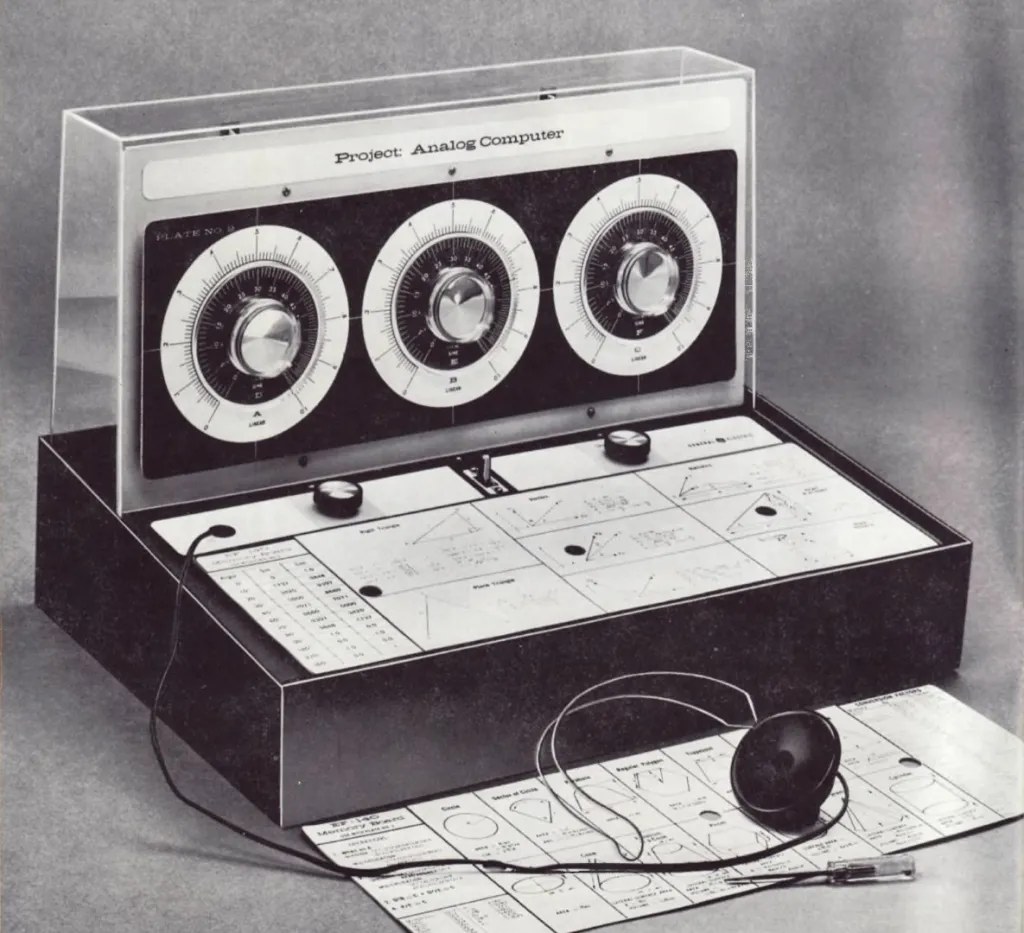
Figure 1 — The working arrangement the problem set assumes: dials above, memory board below, paper and pencil beside. Most of GE’s problems need all three. Photograph: General Electric publicity image.
6.1 About this Volume
General Electric’s manual contains forty-nine numbered problems, running from the multiplication of two two-digit numbers to an eleven-part reconstruction of Alan Shepard’s suborbital flight. The answers are printed at the back.
This volume treats the set as evidence. What a manufacturer chooses to have a student compute says a great deal about who the manufacturer thinks the student is and what the machine is thought to be for — and it says it more reliably than any marketing copy, because a problem set has to actually work.
Every answer quoted here was checked independently. Forty-eight of the forty-nine hold up to the machine’s two-figure precision. One does not, and §8 sets out why.
Cross-references: Vol 4 for the operating procedure; Vol 5 for the scale techniques the problems exercise; Vol 1 §4.2 for the OCR cautions that affect two dates in this volume.
6.2 The Shape of the Set
The problems are distributed through Part 5 in blocks, each following the technique it exercises.
Table 1 — The Shape of the Set
| Problems | Topic | Technique introduced |
|---|---|---|
| 1–2 | Multiplication | linear scales A, B, C; powers of ten |
| 3–5 | Division | dial C as dividend; subtracting exponents |
| 6–8 | Very small numbers | negative exponents |
| 9–16 | Formulas and problem solving | XY = Z and A/B = C forms; memory board |
| 17–19 | Formulas from physics | work, momentum, Ohm’s law |
| 20–27 | Logarithms, powers and roots | scale plate 1, scales D, E, F |
| 28–30 | Compound interest and growth | logarithms applied to (1 + i)ⁿ |
| 31–32 | Radioactive decay | negative logarithms |
| 33–39 | Trigonometric functions | scale plate 2 |
| 40–42 | Ballistics and escape velocity | multi-step chains |
| 43–48 | Additional problems | mixed |
| 49 (a–k) | The Mercury-Redstone flight | everything at once |
The progression is deliberate and well judged: each block requires only what has already been taught, and the final problem requires all of it.
6.3 What GE Chose to Have Students Compute
6.3.1 The Categories
Sorting the forty-nine by subject reveals the manual’s priorities clearly.
Table 2 — 3.1 The Categories
| Subject | Problems | Count |
|---|---|---|
| Spaceflight and rocketry | 40, 41, 42, 47, 48, 49 | 6 (plus 11 sub-parts) |
| Astronomy and the Earth | 9, 22, 23, 24, 43 | 5 |
| Nuclear physics | 31, 32 | 2 |
| Trigonometry, abstract | 33, 34, 35, 36 | 4 |
| Trigonometry, applied | 37, 38, 39, 44 | 4 |
| Pure arithmetic | 1–8, 20, 21, 25, 26, 27 | 13 |
| Geometry and volume | 10, 11, 12, 13, 14, 15, 16 | 7 |
| Classical physics | 17, 18, 19, 45, 46 | 5 |
| Finance and demography | 28, 29, 30 | 3 |
| Sport | (baseball, worked in text) | 0 numbered |
6.3.2 The Curriculum Is the Space Race
Six problems and eleven sub-parts concern rockets, satellites and spaceflight. Two more concern radioactive isotopes “made at Oak Ridge for use in science and industry”. One computes the volume of the Sun against the Earth; one the radius of the Earth from its circumference; one the rise in sea level if the ice caps melted.
The manual is copyright 1961, and its content is precisely calibrated to that year. Problem 47 concerns Explorer I, launched January 1958; problem 48 concerns Sputnik I, launched October 1957; problem 49 concerns Alan Shepard’s flight of 5 May 1961 — an event that must have occurred while the manual was in production.
C. G. Suits’s introduction said the kits were meant to “stimulate many bright young people to pursue careers in engineering or science” (Vol 1 §2). The problem set is that sentence turned into arithmetic. A student who works through it computes the trajectory of an American astronaut, the orbit of a Soviet satellite and the decay of a medical isotope, in that order.
6.3.3 The Gentler Openings
Against that, the set opens disarmingly. The text before problem 9 offers:
“Are you a baseball fan? You can use the computer to figure winning percentages. Simply enter the total number of games played on Scale A of dial X, and the number of games won on Scale C (dial Z); the winning percentage can be read on Scale B (dial Y). Or batting averages: Enter the total times at bat on Scale A and the number of hits on Scale C; again, the average can be read on Scale B.”
And problem 13 — “How many people, tightly packed, would the Empire State Building hold?” — is straightforwardly a joke, though it is followed by a serious question about what percentage of the world’s population that represents.
The pairing is effective: an appealing question establishes the technique, and the technique is then pointed at something consequential.
6.4 The Answers, Checked
The manual prints all forty-nine answers on page 38. Every one was recomputed independently for this series. A representative selection, with the recomputation:
Table 3 — The manual prints all forty-nine answers on page 38. Every one was recomputed independently for this series. A representative selection, with the recomputation
| # | Problem | GE’s answer | Recomputed | Verdict |
|---|---|---|---|---|
| 1 | 23 × 77 | 1,771 | 1,771 | ✓ exact |
| 2 | 438 × 519 | 227,322 | 227,322 | ✓ exact |
| 3 | 29 ÷ .81 | 35.8 | 35.80 | ✓ |
| 4 | 95 ÷ .48 | 198 | 197.9 | ✓ |
| 5 | 211,000 ÷ 137 | 1,540 | 1,540.1 | ✓ |
| 6 | .000000481 × .000052 | 24.9 × 10⁻¹² | 25.01 × 10⁻¹² | ✓ within two figures |
| 7 | .00047 ÷ .063 | .746 × 10⁻² | .7460 × 10⁻² | ✓ |
| 8 | 232 ÷ 1,530,000 | 1.52 × 10⁻⁴ | 1.516 × 10⁻⁴ | ✓ |
| 9 | Distance to Alpha Centauri | 25.4 × 10¹² miles | 25.2 × 10¹² | ✓ within two figures |
| 10 | Area of Central Park | 1.29 sq miles | 1.288 | ✓ (and larger than Monaco’s 0.5) |
| 11 | Volume of the Cheops pyramid | 85.9 × 10⁶ cu ft | 85.73 × 10⁶ | ✓ |
| 12 | Volume of the Empire State Building | 104.5 × 10⁶ cu ft | 104.66 × 10⁶ | ✓ |
| 14 | Volume of a cone, r = 2, h = 3 | 12.57 cu ft | 12.56 (π = 3.14) | ✓ |
| 16 | Area of an ellipse, axes 5 and 2 | 7.85 sq ft | 7.85 | ✓ exact |
| 17 | Height of a pedestal | 23.4 ft | 23.33 | ✓ |
| 19 | Current, 115 V across 32 Ω | 3.6 A | 3.594 | ✓ |
| 22 | Radius of the Earth | 3,960 miles | 3,956 | ✓ |
| 29 | Time to double at 1 % quarterly | 17.5 years | 17.42 | ✓ |
| 31 | Radiocobalt remaining after 15 years | 1.34 g | 1.354 | ✓ |
| 32 | Age of a fossil, ⅛ of C-14 left | 17,160 years | 17,160 (3 half-lives) | ✓ exact |
| 33 | sin 23° | .391 | .3907 | ✓ |
| 34 | cos 40° | .766 | .7660 | ✓ |
| 35 | tan 170° | −.176 | −.1763 | ✓ |
| 36 | cosec 45° | 1.41 | 1.4142 | ✓ |
| 40 | Height of a rocket | 115,200 ft | 115,200 | ✓ exact |
| 41 | Height of an ejected capsule | 115,200 ft | 115,200 | ✓ exact |
| 42 | Weight on Jupiter | 952 lb | 951.4 | ✓ |
| 43 | Volume of the Sun against the Earth | 1.26 × 10⁶ | 1.2597 × 10⁶ | ✓ |
| 44 | Length of a tower’s shadow | 3,600 ft | 3,594 | ✓ |
| 45 | Pressure at 35,000 ft depth | 15,100 psi | 15,167 | ✓ |
| 46 | Total force on the bathyscaphe cabin | 144,000 tons | 144,260 | ✓ |
| 48 | Sputnik I’s average speed | 18,200 mph | 18,240 | ✓ |
The set holds up. General Electric’s answers are consistently correct to the two significant figures the machine delivers, and several are exact.
6.4.1 A Nice Piece of Physics in Problems 40 and 41
Worth pausing on. Problem 40 asks how high a 20,000 lb rocket with 40,000 lb of thrust will climb, burning for one minute. Problem 41 asks how high a 1,000 lb capsule ejected at burnout would go.
Both answers are 115,200 ft — identical.
That is not an error. After burnout the capsule is in free ballistic flight, and the height a projectile coasts to depends only on its velocity and gravity, not on its mass. Problem 41 exists to make a student notice that. It is a genuinely well-constructed question, and the identical answers are the whole point.
Working it through: effective thrust = 40,000 − 20,000 = 20,000 lb; a = F·g/W = 20,000 × 32 / 20,000 = 32 ft/s²; velocity at burnout = 32 × 60 = 1,920 ft/s; powered altitude = ½ × 1,920 × 60 = 57,600 ft; coasting time = 1,920 / 32 = 60 s; coasting altitude = 1,920 × 60 − ½ × 32 × 60² = 115,200 − 57,600 = 57,600 ft; total = 115,200 ft. ✓
6.5 The Mercury-Redstone Problem
Problem 49 is the set’s capstone and occupies a full page with a figure. It is an eleven-part reconstruction of a real flight flown weeks before publication.
“On May 5, 19[6]1, Commander Alan B. Shepard, Jr., became the first American to pierce the space barrier. At lift-off, the weight of the complete Redstone Mercury was 68,000 pounds. The missile had a thrust of 78,000 pounds, and would deliver power for 2.5 minutes, consuming 50,000 pounds of fuel.”
Note — The scan’s text layer reads “May 5, 1981”. Shepard’s flight was 5 May 1961, and the manual is copyright 1961. This is one of the OCR artefacts catalogued in Vol 1 §4.2, not an error by General Electric.
6.5.1 The Eleven Parts
Table 4 — 5.1 The Eleven Parts
| Part | Asks for | GE’s answer |
|---|---|---|
| (a) | Average weight of the rocket over the first 2.5 minutes | 41,000 lb |
| (b) | Average acceleration along the flight path | 44 ft/s² |
| (c) | Speed at separation, 2.5 min after lift-off | 4,500 mph |
| (d) | Altitude at apogee, from 264,000 ft and a +42° trajectory | 115 miles |
| (e) | Total flight time to apogee | 5 minutes |
| (f) | Range and altitude of the capsule at apogee | range 151 miles, altitude 115 miles |
| (g) | Time from apogee to 10,000 ft, where the main chute opens | 4.5 minutes |
| (h) | Range when the main chute opens | 302 miles |
| (i) | Shepard’s apparent weight during re-entry deceleration | 1,600 lb |
| (j) | Total flight time from lift-off to landing | 15 minutes |
| (k) | How long the capsule would float, taking water at 10.5 gal/min | 20 minutes |
6.5.2 Why It Is a Good Problem
Three reasons.
It is genuinely multi-stage. Each part feeds the next: the average weight of (a) gives the acceleration of (b), which gives the velocity of (c), which drives the trajectory of (d) through (h). A student who makes an arithmetic error early carries it through — which is exactly the discipline the machine demands anyway.
It uses nearly every technique in the manual. Multiplication, division, powers of ten, the trigonometric scales for the +42° trajectory, and the ballistic formulas from the memory board.
Part (i) is a physics lesson disguised as arithmetic. It asks what a 160 lb man “weighs” when decelerating at 218 mph per second. Converting: 218 mph/s = 319.7 ft/s², roughly 10 g. Using F = (W/g)·a gives about 1,600 lb — ten times his normal weight. GE’s answer of 1,600 lb is correct, and the point of the question is to make the number felt rather than merely computed.
Part (k) is a joke with a serious answer. A one-ton capsule of about 60 cubic feet taking in sea water at 10.5 gallons per minute: 20 minutes. It is also, in May 1961, a live operational concern — Gus Grissom’s capsule would sink on the next flight in July.
6.6 What the Problems Assume About the Reader
6.6.1 The Mathematical Prerequisites
Reading the set as a whole, a student who can complete it must already be comfortable with:
- decimal arithmetic and scientific notation;
- exponents, including negative ones;
- logarithms, characteristic and mantissa, and negative logarithms;
- trigonometric functions and the identities relating them;
- the formulas for the volume of a cone, a pyramid and a sphere, and the area of an ellipse;
- Newtonian mechanics — work, momentum, acceleration, ballistic trajectories;
- compound interest and exponential decay.
That is an able secondary-school student, and a motivated one. The manual teaches logarithms from scratch in about two pages and then expects them to be applied to radioactive decay four pages later.
6.6.2 Paper and Pencil Are Assumed Throughout
This is the most important structural observation about the set, and it follows from Vol 2 §8: the machine cannot add.
Problem 40’s solution requires subtracting the weight from the thrust, then multiplying, then multiplying again, then subtracting one altitude from another, then adding two altitudes. The machine performs the multiplications. Every subtraction and addition is done by the student, on paper, between machine operations — as is every scaling into the 0-to-1 range and every restoration of a decimal point.
The manual is honest about this by demonstration if not by statement; its worked ballistic solution is a page of written algebra with the machine invoked at intervals. The EF-140 is a calculating aid within a paper-and-pencil workflow, not a machine that solves problems. Vol 7 returns to what that means for its classification.
6.6.3 What the Memory Boards Carry
The problems repeatedly send the student to the memory boards rather than to the manual. Problem 22 asks for the Earth’s radius “Use the memory board conversion table for an answer in miles”. Problems 14 and 15 say “Find the formulas for the volume of a pyramid and of a rectangular structure”. Problem 36 requires the cosecant identity.
The memory boards therefore carry: conversion factors (“for converting miles per hour to feet per minute, horsepower to watts, and so forth”), geometric formulas, a table of logarithms, a table of sine and cosine to 360°, trigonometric identities, and the ballistic formulas. The manual notes they hold “many more formulas than can be discussed in the manual.”
Since the memory boards are printed on the reverse of the scale plates (Vol 4 §4.2), a surviving EF-140 that has lost its plates has lost its formula library as well as its scales.
6.7 Where the Problem Set Strains the Machine
A recurring pattern: many problems require numbers far outside the dials’ range at every stage.
Table 5 — Where the Problem Set Strains the Machine
| Problem | Quantities involved |
|---|---|
| 9 | 186,000 mi/s; 31.5 million s/yr; answer 2.5 × 10¹³ |
| 11 | 756 ft squared, times 450, divided by 3 |
| 23 | Volume of the Earth: 2.6 × 10¹¹ cubic miles |
| 37 | Muzzle velocity 2,000 ft/s squared = 4 × 10⁶ |
| 43 | (864,000 / 8,000)³ |
Every one of these is carried as a mantissa and an exponent by the student. The machine contributes a two-figure product; the operator contributes the magnitude, the bookkeeping and all the addition.
This is not a criticism of the problems — tracking exponents is a skill worth teaching, and the manual teaches it deliberately in problems 1 through 8 before requiring it. But it means the honest description of what the student is learning is “scientific notation, with a multiplication aid” rather than “how to use a computer.”
6.8 The One Answer That Does Not Check
Problem 30. “The world’s population passed the 3 billion mark in 1961, and is growing at a rate of 1.7 % a year. In what year will the world population reach 4 billion if it continues growing at the present rate?”
GE’s answer: 1990.
Recomputing with the manual’s own compound-growth formula A = P(1 + i)ⁿ:
3 × 1.017ⁿ = 4
1.017ⁿ = 1.3333
n = log(1.3333) / log(1.017) = 0.12494 / 0.0073210 = 17.1 years
which gives 1978, not 1990.
Testing the published answer in reverse: 1990 implies n = 29 years, and 1.017²⁹ = 1.63, giving 4.89 billion — not 4 billion. But at a growth rate of 1.0 %, log(1.3333) / log(1.01) = 28.9 years, which lands on 1990 exactly.
The most likely explanation is a transposition between the problem and the answer: the answer was computed for 1 % and the problem states 1.7 %, or vice versa. Either way the two are inconsistent, and a student following the manual’s method correctly would get 1978 and conclude they had made a mistake.
It is worth noting that the correct answer is the more remarkable one. World population did in fact reach 4 billion in 1974 — sooner even than the 1978 the arithmetic predicts, because the growth rate rose above 1.7 % during the 1960s.
Note — This is the only substantive error found in forty-nine problems and eleven sub-parts. That is a good record for a consumer kit manual, and it is worth stating alongside the error rather than leaving the correction to stand alone.
6.9 Two Dates the Scan Gets Wrong
Both are OCR artefacts rather than General Electric’s errors, and both would mislead a reader quoting the text layer. Recorded here because this volume is where they occur.
Table 6 — Two Dates the Scan Gets Wrong
| Text layer reads | Correct | Evidence |
|---|---|---|
| ”By 1980, there were more than 10,000 [computers]“ | 1960 | A book copyright 1961 cannot report 1980; the preceding sentence reads “In 1955, there were less than 100" |
| "On May 5, 1981, Commander Alan B. Shepard, Jr.” | 1961 | Shepard’s flight was 5 May 1961 |
The underlying passage — “In 1955, there were less than 100 giant electronic computers at work in the United States… By 1960, there were more than 10,000 and their number was still on the way up” — is a reasonable popular account of the period and is worth reading as GE wrote it rather than as the scanner read it.
6.10 What the Set Achieves
Assessed on its own terms, the problem set is the strongest part of the kit.
It is honest about the machine. Not one problem pretends the EF-140 does more than it does. The multiplications are multiplications; the additions are left to the student without apology.
It is genuinely progressive. Each block requires only what precedes it, and the final problem requires everything.
It is well aimed. A student in 1961 who wanted to know how high Alan Shepard went could find out, using a machine they had built themselves, from numbers in the newspaper. That is a considerable thing to offer, and the six spaceflight problems are where the kit most nearly delivers on the ambition in its introduction.
It is accurate. Forty-eight of forty-nine answers check out.
Its weakness is the one identified in Vol 5 §3.5 and again in §6.2 here: the manual never tells the student which results the machine can be trusted to two figures and which it cannot, and it never quite says out loud how much of the work the student is doing unaided.
6.11 What Comes Next
Vol 7, the final volume, asks the question the whole series has been circling: given everything established about the circuit, the scales and the problems, what kind of machine is the EF-140 — and was General Electric entitled to call it an analog computer?
Comments (0)