EAI PACE TR-10 · Volume 1
EAI PACE TR-10 — Volume 1 — Overview & history
What the machine is, where it sat in the market, and exactly how much of the record can be trusted — the ground for Volumes 2–7
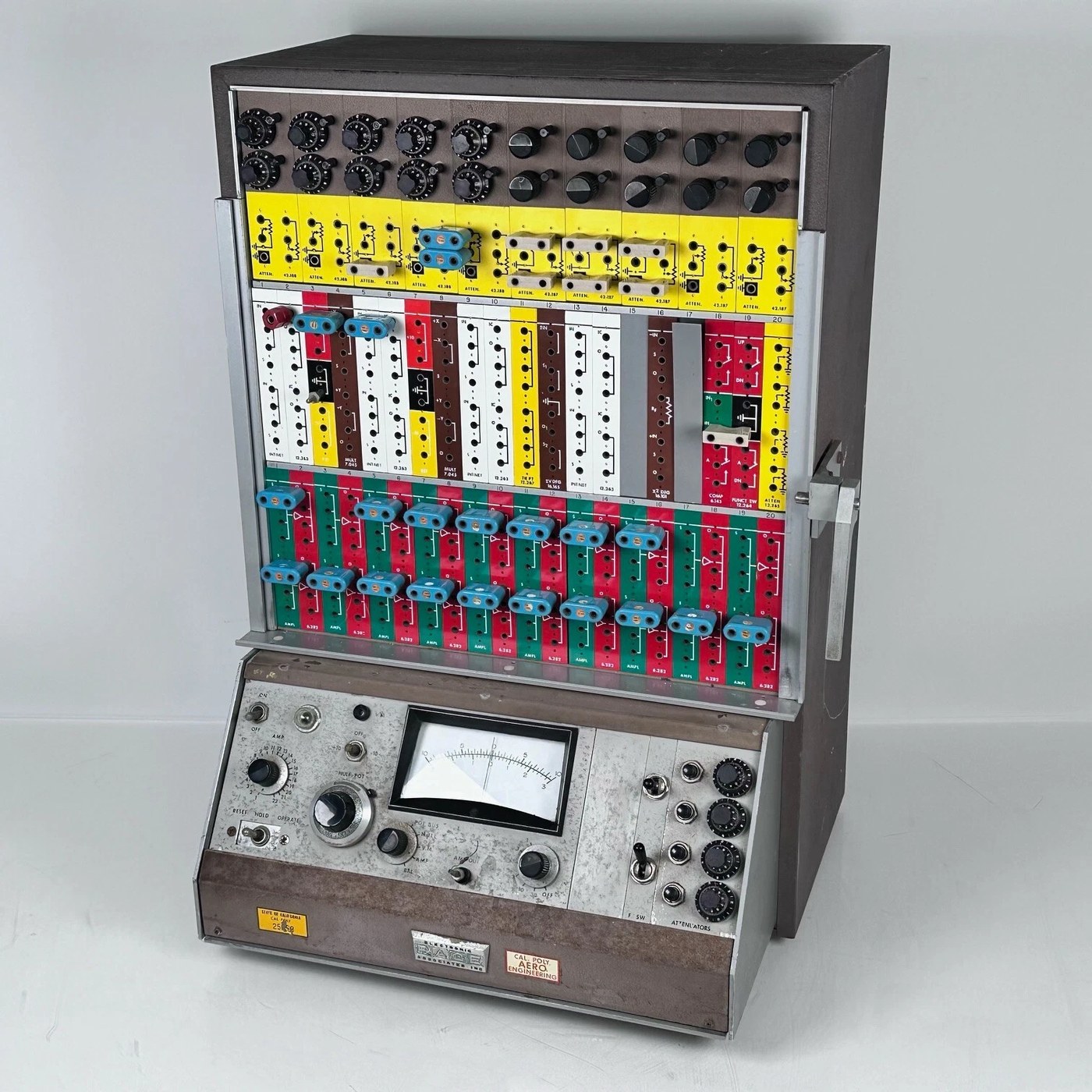
Figure 1 — A surviving TR-10 console, serial no. 70. The three rows of plug-in computing components fill the upper cabinet; the inclined control panel with its null meter occupies the lower third. The colour-coded patch panels are the front faces of the modules themselves — there is no separate patch bay. Photograph: locally held collector image, provenance recorded in photo_credits.txt.
1.1 About This Volume
Volume 1 establishes what the TR-10 is, who built it, when, for whom, and — unusually prominently for an overview volume — how thin the surviving documentation actually is. The TR-10 is not the Heathkit EC-1. No assembly manual, no schematic set, and no operating manual for it is held in this project’s library. What is held is a sixteen-page sales brochure, a seven-page procurement specification, and four German-language dealer newsletters that mention the machine in passing. Everything in Volumes 2 through 7 is built on those documents plus photographs of two surviving consoles, and where they run out this series says so rather than filling the gap.
That constraint is stated first because it changes how the rest of the series should be read. Statements here carry their source. Where two sources disagree — and on this machine they disagree more often than one would expect of a single manufacturer’s own literature — both readings are given.
1.1.1 Depth-Index: The Seven-Volume Series
Table 1 — Depth-Index: The Seven-Volume Series
| Vol | Title | Primary Content |
|---|---|---|
| 1 | Overview & History (this volume) | What the machine is, market position, dating, the documentary record and its limits, specifications quick-table |
| 2 | System Architecture | The four console areas, plug-in philosophy, bus-bar power, the module-face patch panel, colour code, position rules |
| 3 | The Computing Components | Module-by-module catalogue with EAI type numbers: amplifiers, integrator networks, pots, multipliers, function generators, comparator, reference, accessories |
| 4 | Programming & Scaling | Amplitude scaling from first principles, the brochure’s second-order program re-derived and checked, the Van der Pol non-linear program |
| 5 | Time Scaling & Repetitive Operation | Integrator gains, the time-scale factor β, Accessory Group 2.246, the 500:1 change, and where the arithmetic closes |
| 6 | Specifications & the Documentary Record | Specification GPAC-TR-10 PS 6305 in full, set against the brochure; every contradiction catalogued; what remains unsourced |
| 7 | Use, Teaching and Aftermath | How the machine was actually used, the EAI product family, the German dealer record, and the displacement by digital computation |
Note — Cross-references appear throughout as “see Vol N §M.” Each volume is self-contained; Vol 1 assumes no other volume has been read.
1.2 What the TR-10 Is
1.2.1 A Professional Instrument Shrunk to a Desk
The PACE TR-10 is a fully transistorised, plug-in-component, general-purpose electronic analog computer built by Electronic Associates, Inc. of Long Branch, New Jersey, and sold under the company’s PACE trade name. It sits on a desk, draws its power from an ordinary wall outlet, and is programmed by pushing patch cords into the coloured faces of its own computing modules.
The word that does the most work in that description is general-purpose. The TR-10 is not a demonstration device and not a calculator. It is a machine for solving ordinary differential equations in hardware, in parallel, in real time, by wiring together operational amplifiers, integrator networks, coefficient potentiometers and non-linear function generators. In its standard basic configuration the brochure states that it is “capable of solving up to two second-order differential equations plus associated linear algebraic operations.” Expanded to its full complement of twenty amplifiers it will carry considerably more.
Three characteristics separate it from the professional analog installations that preceded it:
- It is solid-state throughout. Every computing element is transistorised. There is no warm-up period, no tube complement to age and drift, and no forced cooling. The brochure makes a point of this repeatedly, and in 1960 it was still a genuine selling point rather than an assumption.
- Every computing element plugs in from the front. Amplifiers, integrator networks, multipliers and function generators are all modules that slide into a pre-wired console. Changing the machine’s capability is a matter of pulling one module and pushing in another; no wiring is involved.
- It is small enough and cheap enough to belong to one engineer. The brochure’s pitch is explicit: “Because of its unique portability, this compact computer can become your personal tool. Carried right to your desk, it can be used to solve your day-to-day problems.”
1.2.2 Where It Sat in the Market
Analog computing in 1960 was stratified. At the top sat room-filling installations costing tens or hundreds of thousands of dollars and run by dedicated staff — EAI’s own large consoles among them. At the bottom sat the educational kit: the Heathkit EC-1, nine vacuum-tube amplifiers for $199.95, aimed at a student or a curious engineer.
The TR-10 occupies a band that barely existed before it. It is a professional-grade instrument — 0.1 % readout accuracy, 20 µV amplifier offset, precision wire-wound patching resistors — in a package one person can own and operate. EAI’s own brochure positions it in exactly those terms, and does so from both directions:
“Companies who already have large analog computer installations will find the PACE TR-10 can be used to solve smaller problems and eliminate tie-ups and excessive waiting time for large equipment. It is ideal for breaking-in new engineers to the advantages and techniques of analog computation.”
That is a machine sold both as a first computer and as a relief valve for an overloaded big one.
Table 2 — Where It Sat in the Market
| Heathkit EC-1 | EAI PACE TR-10 | Large analog installation | |
|---|---|---|---|
| Computing elements | 9 amplifiers | 10–20 amplifiers | dozens to hundreds |
| Technology | vacuum tube | transistor | tube, then transistor |
| Signal range | ±60 V | ±10 V | ±100 V, later ±10 V |
| Readout | 50-0-50 µA panel meter | null meter, 0.1 % | digital voltmeter |
| Reconfiguration | rewire the patch board | swap a plug-in module | swap a module |
| Bought by | students, hobbyists, schools | individual engineers, departments | institutions |
| Form factor | bench cabinet | desk top | room |
1.2.3 What the Machine Does, in One Paragraph
A variable in the problem is represented by a voltage. An operational amplifier with a resistor in its feedback path adds and scales voltages; the same amplifier with a capacitor in its feedback path integrates one with respect to time. A coefficient potentiometer multiplies a voltage by a constant between zero and one. Wire enough of these together in the pattern of a differential equation and the machine’s voltages will, from the moment the operator presses OPERATE, evolve exactly as the equation’s variables do. The answer is not computed step by step; it is exhibited, continuously, by a circuit that obeys the same mathematics as the system being studied. Vol 4 develops this properly.
1.3 The Documentary Record
1.3.1 The Three Primary Sources
Everything asserted in this series about the TR-10 traces to one of the following. Their character matters as much as their content.
Table 3 — The Three Primary Sources
| Source | What it is | Reliability |
|---|---|---|
| PACE TR-10 Analog Computer, EAI Bulletin No. AC 934–… | 16-page colour sales brochure. Console photographs, module-by-module component descriptions with type numbers, two fully worked programs, row capacities and position rules, physical description. | The richest source by far, but it is sales literature. Its two worked programs are technically detailed and check out arithmetically; its round numbers and superlatives do not all survive scrutiny, and it contradicts itself in at least three places. |
| Specifications for General Purpose Desk-Top Analog Computer (TR-10), document GPAC-TR-10 PS 6305 | 7-page procurement specification, EAI letterhead. Numbered clauses stating required performance for every subsystem. | A requirements document, not an as-built description. Everything in it is phrased “shall be”. It describes the machine EAI undertook to deliver, which is not always the machine the brochure describes. |
| EAI-Report / Mitteilungsblatt, nos. 1, 2 and 7 (1965–66) | German-language dealer newsletters from EAI Electronic Associates GmbH, Aachen. English translations held in this project’s library. | Incidental but valuable: they show the TR-10 still in the field years after the brochure, and no. 1 gives a step-by-step field modification to its integrator networks. |
Two further classes of evidence are used and labelled as such: photographs of a privately held console bearing serial no. 70, and photographs of the machine displayed at the National Cryptologic Museum together with its exhibit placard.
1.3.2 What Is Not Held
There is no operating manual, no maintenance manual and no schematic for the TR-10 in this project’s library. This matters concretely:
- Component-level circuit description is impossible. Vol 3 describes what each module does and what it is specified to achieve; it cannot walk a signal through a transistor stage the way the EC-1 series does, because the schematic does not exist here.
- The EAI-Report no. 1 modification article cites “TR-10 Maintenance Manual, sheet B 012 425 OS, Schematic Integrator Netw.” That manual demonstrably existed. It is simply not held.
- No price list, no production figures and no serial-number range are held. Any number of those kinds appearing elsewhere should be treated as unsourced until a document is produced.
Note — A reader arriving with an actual TR-10 and a fault should regard this series as orientation, not as a service manual. Vol 6 lists what would need to be obtained.
1.4 Dating the Machine
The TR-10’s introduction date is not stated in any held source. Four independent indications bracket it:
Table 4 — The TR-10's introduction date is not stated in any held source. Four independent indications bracket it
| Evidence | Indication |
|---|---|
| National Cryptologic Museum exhibit placard | ”PACE-TR-10 ca. 1960” |
| Brochure text and styling | Emphasises “completely solid-state” as a novelty; no transistor type numbers; typography and colour work consistent with c. 1959–61 |
| Specification number PS 6305 | If the trailing digits are a year-month date code, this reads as May 1963 — a plausible but unconfirmed reading |
| German dealer newsletters | TR-10 still an actively supported product in 1965 and 1966; newsletter no. 1 (July 1965) offers a modification to bring existing TR-10 integrator networks “up to the latest standard” |
The defensible statement is therefore: in production by about 1960, still current and supported in 1966. Anything more precise than that is not supported by the documents held here.
The museum placard adds one further claim worth recording carefully, because it is institutional but not technical:
“The PACE-TR-10 is believed to be the first desktop analog computer used at NSA. Programming was accomplished by manually interconnecting its components to solve complex mathematical equations. The ideal duration of a single run was from 15 to 60 seconds, not counting set-up time. The PACE-10 itself required an extensive knowledge of mathematics to operate.”
The first and last sentences are institutional memory and are credible as such. The middle claim — a 15-to-60-second run — sits awkwardly against the manufacturer’s own literature, which describes both real-time operation of arbitrary duration and a repetitive mode running solutions in 20 to 500 milliseconds. The placard is most likely describing how that particular installation was used in practice, not a property of the machine. Vol 5 returns to this.
1.5 Physical Description and Specifications Quick-Table
1.5.1 Physical
Table 5 — Physical
| Parameter | Value | Source |
|---|---|---|
| Width | 16 in | brochure, “Physical Description” |
| Height | 24 in | brochure |
| Depth | 15 in | brochure |
| Weight | ~95 lb, fully expanded | brochure |
| Power source | 115 V, 50–60 cycle | brochure |
| Power requirement | under 50 W, fully expanded | brochure |
1.5.2 The Machine’s Numbers
Table 6 — The Machine's Numbers
| Parameter | Value | Source |
|---|---|---|
| Signal range | ±10 V | spec §3.3 |
| Amplifier output current | 20 mA at ±10 V | spec §3.3 |
| Operational amplifiers | up to 20 (10 dual modules) | brochure p. 12; spec §1.3 |
| Coefficient potentiometers | up to 24 | spec §1.4 |
| Amplifier bandwidth | 200 kc minimum | spec §3.4 |
| Offset at summing junction, after balance | ≤ 20 µV | spec §3.6 |
| Gain-one integrator drift | ≤ 50 µV/s | spec §3.7 |
| Integrating capacitors | 10 µF, ±0.1 % polystyrene | brochure; spec §3.8 gives ±0.1 % |
| Potentiometers | 10-turn, 5000 Ω, resolution 0.025 % typical | spec §4 |
| Readout | null meter, 0.1 % as null, 2 % as voltmeter | spec §2.4.2.1; brochure p. 4 |
| Multipliers | quarter-square, ≤ ±0.4 % of full scale | spec §5.2 |
| Reference supply | ±10 V at 50 mA | spec §9.1 |
| Repetitive solution rate | 20–500 ms per solution; ≥ 33 solutions/s | spec §11.6.2 |
1.5.3 Where the Two Documents Disagree
This table is the reason Vol 6 exists. None of these are small transcription slips in a secondary source; they are divergences within EAI’s own paperwork.
Table 7 — Where the Two Documents Disagree
| Point | Specification PS 6305 | Brochure | Comment |
|---|---|---|---|
| Size envelope | ”no greater in size than 16″ W × 23″ H × 16″ D” (§1.1) | 16″ W × 24″ H × 15″ D | The delivered machine is one inch taller than the specification’s ceiling and one inch shallower |
| Weight | ”shall weigh no more than one hundred (100) pounds” (§1.1) | ~95 lb | Consistent: the spec sets a ceiling, the brochure reports the outcome |
| Power | not stated in watts | ”under 50 watts (fully expanded)” on p. 13, but “no more power than a 60 watt light bulb” on p. 2 | The brochure contradicts itself |
| Feedback resistors | 100 kΩ only (§11.1.1) | two values, 10 kΩ and 100 kΩ | The product shipped more than the spec required |
| Input resistors | 10 kΩ or 100 kΩ (§11.2.1) | four values: 1 kΩ, 10 kΩ, 100 kΩ, 1 MΩ | As above |
| Rep-op integrator network | not typed | Type 12.425 on p. 8 and on the module’s own silkscreen; “Type 12.245” on p. 12 | Almost certainly a transposition on p. 12; the German newsletter independently says 12.425 |
| Variable DFG models | not typed | 16.165 / 16.156 / 16.154 on p. 9; 16.154 / 16.155 / 16.165 on p. 12 | The middle model’s number differs between two pages of one brochure |
Tip — When these documents conflict on a capability, the brochure is generally the better guide, because it describes shipped hardware. When they conflict on a performance limit, the specification is the better guide, because limits are what it exists to state. Neither rule is safe without checking, and Vol 6 checks each case individually.
1.6 What Is Not Known
Stated plainly, so that no later volume has to imply otherwise:
- Price. No price for the TR-10, in any configuration, appears in any source held here. The machine’s cost relative to the EC-1 or to a large installation can be reasoned about qualitatively and no further.
- Production quantity and dates. Unknown. The one console photographed in detail for this series carries serial no. 70, which is a data point about that machine and nothing more.
- Circuit design. The amplifier is specified as “chopper stabilized” and “fully transistorized” and is described as such in Vol 3. Its actual topology is not held.
- The expansion of “PACE”. The trade name appears throughout EAI’s literature without being expanded. A widely repeated expansion exists; because no held document confirms it, this series uses “PACE” as the trade name it is.
- The rep-op integrator capacitor value. The 500:1 time-scale change is specified; the capacitor that achieves it is not. Vol 5 derives what it would have to be and labels the derivation as inference.
1.7 Why the Machine Matters
Three reasons, in ascending order of durability.
It made analog computation personal. The large analog installation was a shared, scheduled, staffed resource — its economics resembled those of the mainframe. The TR-10’s proposition was that an engineer could keep one on a desk and turn a knob to watch a damping ratio change. That is a different relationship with a computing machine, and it arrived on the analog side of the fence several years before the minicomputer delivered it on the digital side.
Its architecture is the argument in miniature. Four rows, colour-coded, every computing element a module whose front face is its patch panel. Nothing about the machine is hidden behind a cabinet door. Vol 2 treats this as an engineering decision with consequences, not merely a styling choice.
It marks the ceiling of the approach. The TR-10 is close to the best that could be done with the analog paradigm in a desk-sized package: 0.1 % readout, 20 µV offsets, 200 kc bandwidth, parallel real-time solution of coupled non-linear differential equations. Within about a decade, general-purpose digital machines would be solving the same equations to more figures, storing the programs, and printing the results. Understanding what the TR-10 did well is the only way to understand what was actually lost in that transition — real-time parallel solution and the immediacy of a knob — and what was gained.
1.8 What Comes Next
Vol 2 opens the console: the four areas that accept plug-in components, the capacities and position rules of each row, the bus-bar power distribution, and the colour code that turns a wall of identical-looking modules into a readable patch field. Vol 3 catalogues every module EAI offered, by type number and specification. Readers who want to program the machine rather than understand its hardware should go directly to Vol 4, which develops scaling from first principles and re-derives the brochure’s own worked examples, and then Vol 5 for time scaling. Vol 6 is the documentary apparatus: the full specification, every contradiction, and the list of what would need to be found. Vol 7 places the machine in EAI’s product line and in the history of computing.
Comments (0)